Folic acid gummies sit at the intersection of two strong supplement categories: convenient gummy vitamins and products designed around folate intake. They can be developed as standalone vitamin B9 supplements, part of women’s wellness ranges, or as one component of broader multivitamin and prenatal-oriented product concepts.
Yet the apparent simplicity of folic acid gummies can be misleading.
Folic acid is needed in relatively small quantities compared with many minerals or botanical ingredients, so fitting the active into a gummy is usually not the main challenge. The more important questions involve nutrient form, serving level, manufacturing accuracy, ingredient distribution, stability, labeling, target consumer, and how the product is positioned without making inappropriate medical claims.
There is also an important distinction between folate and folic acid. Folate is the general term for vitamin B9 compounds, while folic acid is the form commonly used in fortified foods and dietary supplements. FDA explains that U.S. labels declare folate in micrograms of Dietary Folate Equivalents, or mcg DFE, with added folic acid shown in parentheses when applicable.
For a supplement brand, this means developing folic acid gummies is not simply a matter of selecting “400 mcg” and moving directly to packaging. The finished product should be built around a clearly defined consumer, an appropriate nutrient specification, a practical serving size, validated manufacturing controls, and labeling that accurately reflects what is in the gummy.
Why Folic Acid Gummies Need a Clearly Defined Target Consumer
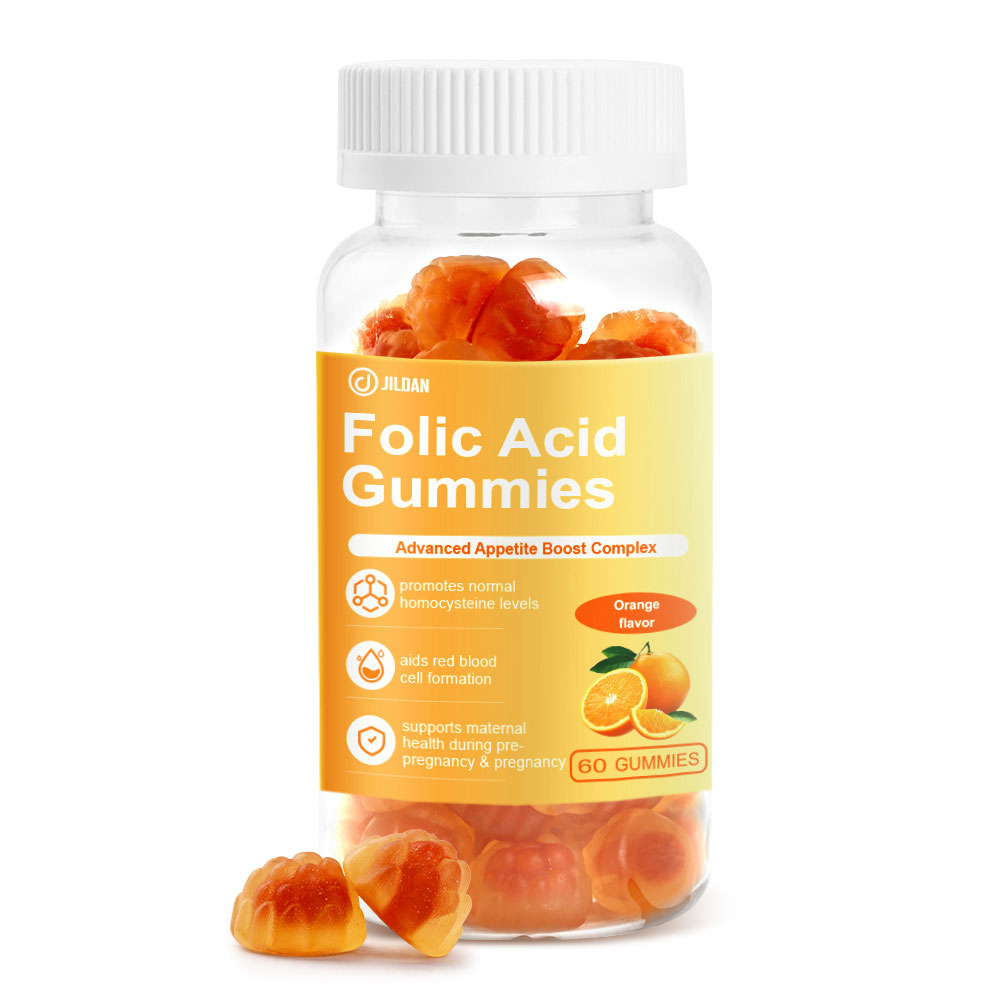
The first step in developing folic acid gummies is deciding who the product is actually for.
Folic acid is often closely associated with women who may become pregnant because of its established role in reducing the risk of neural tube defects when consumed at the recommended amount before and during early pregnancy. CDC currently recommends that women capable of becoming pregnant get 400 micrograms of folic acid daily.
However, that does not mean every product containing folic acid should automatically be marketed as a prenatal supplement.
A brand might develop folic acid gummies for:
- general adult vitamin B9 supplementation;
- women of reproductive age;
- women’s daily wellness;
- a broader B-complex concept;
- a multivitamin gummy;
- a prenatal-oriented formula developed with appropriate professional review.
These are different product positions.
A general wellness gummy may emphasize everyday vitamin supplementation. A product intended for women capable of becoming pregnant requires much more careful attention to serving level, label communication, warnings, and the overall nutrient profile.
A true prenatal-oriented product is more complex still, because folic acid is only one part of the nutritional requirements associated with pregnancy.
The strongest folic acid gummies therefore begin with a narrowly defined consumer rather than attempting to appeal simultaneously to every person who might use folate.
Folate and Folic Acid Are Related, but They Are Not Identical Terms
One of the most important educational points for brands is understanding the terminology.
Folate refers broadly to forms of vitamin B9. Naturally occurring folates are present in foods such as leafy green vegetables, beans, and certain fruits. Folic acid is a form used in fortified foods and many dietary supplements.
CDC specifically notes that folic acid is the form of folate shown to help prevent neural tube defects.
For folic acid gummies, this distinction matters in both formulation and labeling.
Brands may encounter ingredient options described as:
- folic acid;
- folate;
- methylfolate;
- 5-MTHF;
- other folate forms.
These should not automatically be treated as interchangeable from a regulatory, evidence, or labeling standpoint.
Before selecting an ingredient, ask:
- What exact folate form is being supplied?
- What is its purity specification?
- How is it declared on the target market label?
- How is the amount converted to mcg DFE where required?
- What evidence supports the intended product positioning?
- Does the ingredient have specific stability requirements?
A manufacturer producing folic acid gummies should be able to distinguish the ingredient specification from the consumer-facing nutrient declaration.
Understanding mcg DFE Is Essential for U.S. Labeling
One of the most common areas of confusion in folate supplements is the use of Dietary Folate Equivalents.
FDA requires folate to be declared in mcg DFE on U.S. Nutrition Facts and Supplement Facts labels because different forms of folate have different bioavailability. If folic acid is added, the actual amount of folic acid must also be shown in parentheses.
For example, a Supplement Facts panel is not necessarily constructed simply by placing the raw ingredient weight next to the word “folate.”
Product developers working on folic acid gummies should establish the label calculation during formulation rather than after artwork is already underway.
FDA currently identifies the Daily Value for folate as 400 mcg DFE for adults and children four years and older. Pregnancy and breastfeeding involve different dietary reference needs, which is another reason audience definition matters.
A practical development process should therefore align:
- raw-material amount;
- folic acid amount;
- mcg DFE declaration;
- percentage Daily Value;
- serving size;
- gummies per serving.
Errors in any one of these areas can require artwork revisions and delay launch.
How Much Folic Acid Should Be Put Into a Gummy?
There is no universal commercial formula that every brand should copy.
For women capable of becoming pregnant, CDC recommends 400 mcg of folic acid per day to help prevent neural tube defects.
That recommendation is highly relevant when developing certain folic acid gummies, but the final serving should still be reviewed within the context of:
- target consumer;
- total diet;
- fortified foods;
- other supplements;
- other folate sources in the formula;
- intended market;
- professional or regulatory review.
Brands should be especially cautious about assuming that more folic acid automatically creates a better product.
High-dose products may be appropriate only for specific circumstances under medical guidance. CDC, for example, discusses a much higher 4,000 mcg recommendation for women with a previous neural tube defect-affected pregnancy who are planning another pregnancy, but this is a special circumstance and should not be turned into a general consumer dosage strategy.
For mainstream folic acid gummies, the formula should reflect the intended population rather than the highest number that can be printed on the label.
Folic Acid vs Methylfolate: A Product Positioning Decision
Brands developing folic acid gummies frequently encounter questions about folic acid versus methylfolate.
This is partly driven by consumer interest in different folate forms and online discussion about genetic variation.
The important point for manufacturers and brand owners is that ingredient choice should be based on the intended product, evidence, regulatory requirements, stability, and target-market communication—not simply on which term sounds more advanced.
CDC continues to recommend folic acid for women capable of becoming pregnant and states that folic acid is the only form of folate shown to help prevent neural tube defects.
This does not mean other forms have no nutritional role. It means brands should avoid making unsupported claims that one form universally replaces another for every purpose.
When comparing ingredients for folic acid gummies, evaluate:
| Factor | Questions to Ask |
|---|---|
| Ingredient Form | Folic acid, methylfolate, or another folate form? |
| Evidence | Does the evidence match the intended positioning? |
| Stability | Will the ingredient remain within specification in a gummy? |
| Labeling | How must it be declared in the destination market? |
| Cost and Supply | Is the ingredient consistently available? |
| Consumer Positioning | Does the ingredient choice create meaningful differentiation? |
The best choice is the one that can be technically justified and communicated accurately.
Folic Acid Gummies Are Well Suited to Low Active-Load Formulation
One advantage of folic acid gummies is that folic acid is required in microgram quantities rather than the hundreds of milligrams needed for many minerals or botanicals.
That generally makes physical active loading easier.
However, low-dose nutrients create a different challenge: uniform distribution.
When an active ingredient represents only a very small fraction of the total gummy mass, the manufacturing process needs to ensure that the nutrient is evenly distributed throughout the batch.
If mixing is inadequate, individual gummies could potentially contain different amounts of the active ingredient.
This is why formulation should consider:
- premixing strategy;
- carrier systems;
- ingredient dispersion;
- batch mixing;
- addition sequence;
- sampling plan;
- finished-product potency testing.
For folic acid gummies, accurate microgram-level dosing can be more important than solving the physical space problems seen in high-dose mineral gummies.
The manufacturer should therefore have a documented approach to handling low-dose micronutrients.
A Single-Ingredient Gummy or a Multi-Nutrient Formula?
Folic acid can be positioned alone or combined with other nutrients.
A standalone folic acid gummies product offers simplicity.
The consumer can easily understand:
- what the product contains;
- how much is provided;
- why the nutrient was selected.
However, many brands prefer broader women’s wellness or vitamin formulas.
Potential companion nutrients may include:
- vitamin B12;
- vitamin B6;
- vitamin D;
- iron;
- other vitamins and minerals.
The addition of each ingredient changes the technical and nutritional profile.
A multi-nutrient formula should not be built by adding every ingredient commonly associated with women’s wellness.
Instead, ask:
- Does the nutrient fit the target consumer?
- Can it be delivered at a meaningful amount?
- Does it create taste or stability problems?
- Does it require new warnings?
- Does the combination make the product easier or harder to explain?
For folic acid gummies, simplicity can be commercially valuable, especially when the brand wants a clear vitamin B9 product rather than a complete multivitamin.
Iron Can Make the Formula Much More Difficult
Iron is often discussed alongside folate in women’s nutrition, but it changes gummy development significantly.
Folic acid itself requires very little physical space. Iron does not.
Adding iron may introduce:
- metallic flavor;
- color changes;
- oxidation concerns;
- increased active mass;
- texture issues;
- more complex target-consumer considerations.
That means folic acid gummies containing iron should be treated as a different formulation project from a simple folic acid gummy.
Brands should not assume that because two nutrients are often discussed together nutritionally, they are equally easy to formulate.
If iron is included, the manufacturer should evaluate:
- iron form;
- elemental iron contribution;
- serving size;
- flavor masking;
- interactions;
- stability;
- finished-product testing.
Sometimes it is commercially preferable to keep folic acid gummies focused and develop an iron-containing product separately.
Pectin or Gelatin: Choosing the Gummy Base
The gummy base affects the product’s texture, positioning, and manufacturing behavior.
Pectin-Based Folic Acid Gummies
Pectin can support plant-based and vegan concepts.
It can produce a clean bite and is widely used in modern supplement gummies.
However, pectin requires careful control of:
- acidity;
- soluble solids;
- temperature;
- moisture;
- setting conditions.
Gelatin-Based Folic Acid Gummies
Gelatin creates a different chew and elasticity profile.
It may offer different manufacturing characteristics but does not support vegan or vegetarian positioning.
Because folic acid gummies have a relatively low active load, the choice between pectin and gelatin is more likely to be driven by:
- brand positioning;
- texture preference;
- market demand;
- manufacturing platform;
- supporting ingredients.
Brands can review JD Nutra’s broader gummy supplement range when considering how a folic acid product fits into a larger gummy portfolio.
Sugar-Free and Reduced-Sugar Options Need Full Formulation Development
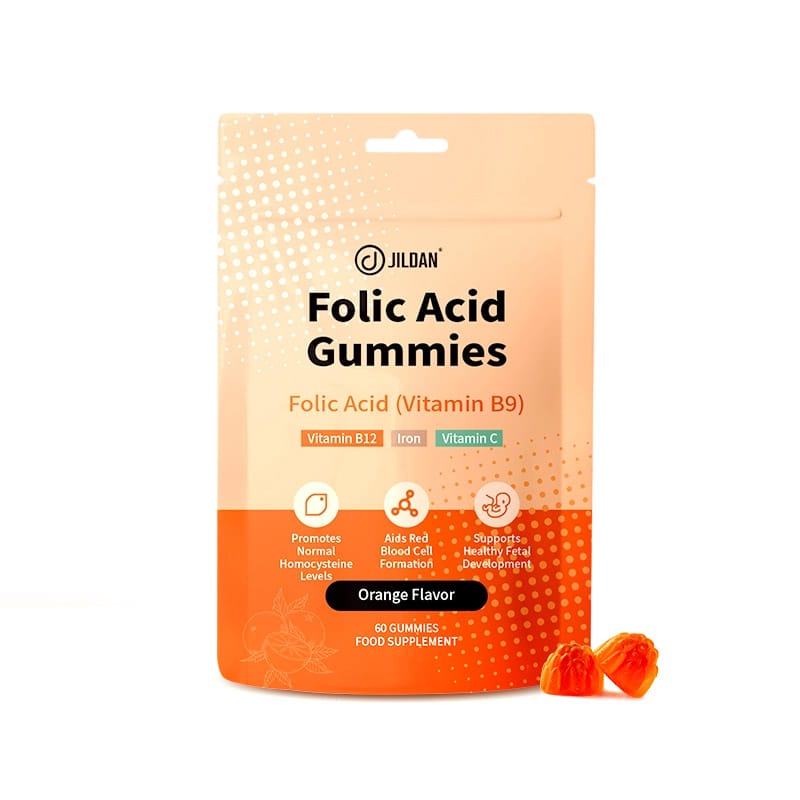
Consumers increasingly look for gummy supplements with less sugar.
That makes reduced-sugar and sugar-free folic acid gummies commercially interesting.
However, sugar plays several roles in a gummy beyond sweetness.
It affects:
- solids;
- texture;
- water activity;
- processing;
- flavor;
- shelf stability.
Replacing sugar requires a formulation built specifically around alternative sweeteners and bulking ingredients.
The good news is that folic acid gummies generally do not need to mask the intense bitterness associated with high-dose botanical extracts. That can make flavor development somewhat easier.
Still, sugar-free formulas need careful evaluation for:
- sweetness quality;
- aftertaste;
- texture;
- digestive tolerance;
- moisture behavior;
- long-term stability.
A stock conventional gummy should not simply have the sugar removed and be treated as a finished sugar-free formula.
Flavor and Color Should Support Daily Use
Because folic acid gummies can be used as part of a daily supplementation routine, consumer experience matters.
A product that tastes unpleasant is less likely to support consistent use.
Common flavor directions might include:
- strawberry;
- mixed berry;
- raspberry;
- citrus;
- orange;
- peach;
- tropical fruit.
The specific choice should reflect the target audience and any supporting nutrients in the formula.
Color also deserves attention.
Brands increasingly prefer naturally derived color systems, but natural colors can have their own stability characteristics.
A formulation team should evaluate whether the finished folic acid gummies maintain acceptable:
- color;
- flavor;
- aroma;
- texture;
- surface condition
throughout shelf life.
Sensory quality is part of product quality, even when the active ingredient remains chemically stable.
Stability Still Matters Even With a Small Amount of Active Ingredient
A small serving level does not eliminate the need for stability testing.
The finished folic acid gummies need to remain within the agreed folate specification for the stated shelf life.
Potential influences include:
- heat during production;
- moisture;
- light;
- oxygen;
- acidity;
- other nutrients;
- packaging;
- storage temperature.
The manufacturer may need to establish an appropriate nutrient overage to account for expected losses during production and storage.
This should not be guessed.
A rational overage should be based on:
- process experience;
- formula characteristics;
- ingredient data;
- stability results.
Brands should ask:
- What amount is targeted at production?
- What amount must remain at the end of shelf life?
- What stability data support the difference?
- Is the final package included in the program?
For folic acid gummies, this provides much more confidence than a label claim based solely on initial raw-material calculation.
Packaging Should Protect Potency and Gummy Quality
Packaging is part of the finished product.
Common packaging options for folic acid gummies can include bottles, jars, or pouches, depending on the project.
When selecting packaging, consider:
- moisture protection;
- light exposure;
- closure integrity;
- serving count;
- gummy dimensions;
- headspace;
- shipping environment;
- consumer opening frequency.
A bottle that is opened daily for several months experiences a different environment from an individually sealed format.
The best package balances stability with convenience and brand presentation.
The package configuration used for stability assessment should ideally match the intended commercial product.
Changing packaging materials late in development can affect the relevance of earlier stability data.
Finished-Product Testing Should Verify the Actual Gummy
Raw-material documentation is important, but brands should also establish finished-product specifications.
For folic acid gummies, a quality plan may include:
- folate or folic acid potency;
- gummy weight;
- appearance;
- microbiological limits;
- relevant contaminants;
- moisture-related characteristics;
- packaging integrity.
The Certificate of Analysis should correspond to an identifiable batch.
Brands should ask the manufacturer:
- Is potency measured on the finished gummy?
- What analytical method is used?
- How is batch uniformity monitored?
- What are the acceptance limits?
- What happens if the result is outside specification?
- Are retain samples kept?
FDA dietary supplement CGMP requirements establish manufacturing and quality-control expectations for dietary supplements, making documented specifications and batch controls important parts of commercial production.
JD Nutra’s supplement manufacturing services can be reviewed when planning the broader process from formulation through production, testing, and packaging.
Labeling Folic Acid Gummies Correctly in the United States
The folate declaration is one of the most technically important parts of U.S. labeling for folic acid gummies.
FDA requires folate to be declared using mcg DFE. When folic acid is added, the folic acid quantity must also appear in parentheses.
This means the final label needs to distinguish carefully between:
- the amount of folate expressed as DFE;
- the actual folic acid amount;
- percentage Daily Value.
FDA’s Dietary Supplement Labeling Guide provides broader guidance on Supplement Facts formatting and dietary ingredient declaration.
Brands should therefore avoid designing the Supplement Facts panel from a raw ingredient quotation alone.
The final label should be built from the approved formula and reviewed for the intended market.
Pregnancy-Related Messaging Requires Particular Care
Folic acid has one of the clearest established public-health recommendations in the vitamin category.
CDC recommends that all women capable of becoming pregnant get 400 mcg of folic acid daily because adequate folic acid before and during early pregnancy helps prevent neural tube defects.
This provides an important evidence base, but brands still need to communicate carefully.
Not every bottle of folic acid gummies should automatically be described as a complete prenatal supplement.
A prenatal formula typically involves more than one nutrient and needs to consider the broader nutritional requirements of pregnancy.
Brands should avoid language that implies that folic acid gummies alone provide complete pregnancy nutrition.
A more responsible content approach explains:
- what folic acid is;
- why adequate intake matters;
- who public-health recommendations apply to;
- what amount the product provides;
- that individual nutritional needs may require professional guidance.
Clear educational content can be more persuasive than exaggerated benefit claims.
Folic Acid Gummies Should Complement, Not Replace, Food
Another important message is that supplementation does not remove the value of a varied diet.
Natural folate is found in foods including leafy green vegetables, beans, peas, oranges, and other foods. Folic acid is also added to certain enriched and fortified foods.
For folic acid gummies, this creates an opportunity for useful consumer education.
A product page or blog can explain that vitamin supplementation exists within a larger nutritional context rather than positioning gummies as a substitute for food.
This kind of content improves trust and helps brands avoid unrealistic wellness messaging.
How to Evaluate a Folic Acid Gummies Manufacturer
A manufacturer for folic acid gummies should be evaluated on more than gummy appearance.
Nutrient Formulation Capability
Ask:
- Which folate forms can be supported?
- Can the team calculate mcg DFE correctly?
- How is microgram-level active distribution controlled?
- How are overages established?
Gummy Manufacturing Experience
Ask:
- Are pectin and gelatin systems available?
- Can vegan products be developed?
- Are sugar-free formulations possible?
- How are low-dose actives dispersed?
Quality Control
Ask:
- What incoming tests are performed?
- Is finished-product potency tested?
- What appears on the COA?
- How are batch records maintained?
Stability
Ask:
- How is shelf life established?
- Does stability include folate potency?
- Is commercial packaging evaluated?
Label Support
Ask:
- Can Supplement Facts calculations be supported?
- Is mcg DFE handled correctly?
- Can market-specific label requirements be reviewed?
These questions help identify whether the manufacturer understands folic acid gummies as a nutritional product rather than simply another gummy SKU.
What to Include in a Folic Acid Gummies RFQ
A strong RFQ should include enough detail for the manufacturer to assess technical feasibility.
Product Positioning
Specify:
- target consumer;
- intended market;
- sales channel;
- single-ingredient or combination concept.
Active Ingredient
Define:
- folic acid or other folate form;
- target amount;
- desired mcg DFE;
- ingredient documentation requirements.
Gummy Requirements
Include:
- pectin or gelatin;
- gummies per serving;
- flavor;
- color;
- sugar level;
- vegan requirements.
Supporting Nutrients
List any proposed:
- vitamin B12;
- vitamin B6;
- iron;
- vitamin D;
- additional vitamins or minerals.
Quality Requirements
Specify:
- finished-product potency;
- microbiological requirements;
- contaminant limits;
- COA;
- stability expectations.
Packaging
Provide:
- bottle or pouch preference;
- gummy count;
- label;
- carton;
- destination market.
Once these specifications are clear, brands can contact JD Nutra to discuss formula development, testing, packaging, and production requirements.
Common Mistakes Brands Make With Folic Acid Gummies
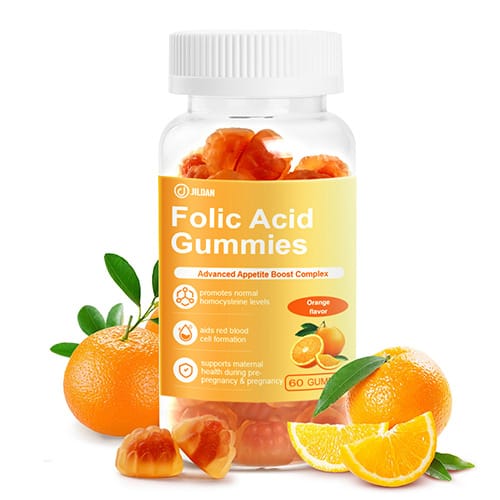
Confusing Folate and Folic Acid
The terms are related but should not be used carelessly when discussing ingredient form, evidence, or labeling.
Ignoring mcg DFE
U.S. folate labeling requires the DFE system to be understood correctly.
Using Pregnancy Messaging Too Broadly
A folic acid supplement is not automatically a complete prenatal product.
Assuming More Is Better
A higher dose is not automatically more appropriate for the target consumer.
Failing to Control Low-Dose Uniformity
Microgram-level actives require careful mixing and verification.
Adding Too Many Supporting Nutrients
A simple folic acid gummies concept can become technically complicated when minerals and other high-load nutrients are added.
Finalizing Artwork Before the Formula
Serving size and Supplement Facts need to reflect the approved finished product.
Ignoring Stability
The label amount should remain supported throughout the intended shelf life, not only on production day.
FAQ
What Are Folic Acid Gummies?
Folic acid gummies are chewable dietary supplements containing folic acid, a form of vitamin B9 commonly used in supplements and fortified foods.
Is Folic Acid the Same as Folate?
Folate is a broad term for vitamin B9 compounds. Folic acid is a specific form of folate commonly used in fortified foods and supplements.
How Much Folic Acid Is Recommended for Women Who Could Become Pregnant?
CDC recommends that all women capable of becoming pregnant get 400 mcg of folic acid daily.
Can Folic Acid Gummies Be Vegan?
Yes. Pectin-based folic acid gummies can be developed for vegan product positioning when the full ingredient and processing system meets the required standard.
Can Folic Acid Gummies Be Sugar-Free?
Yes, but sugar-free products require a dedicated gummy formulation using appropriate alternative sweetener and bulking systems.
Can Folic Acid Gummies Include Vitamin B12?
Yes. Folic acid can be combined with vitamin B12 or other nutrients, but the finished formula should be designed around a clear nutritional purpose and tested for stability.
Why Does the Label Show Folate in mcg DFE?
FDA uses Dietary Folate Equivalents because different forms of folate have different bioavailability. Added folic acid is also shown separately in parentheses on applicable U.S. labels.
What Should Brands Ask a Folic Acid Gummies Manufacturer?
Ask how the manufacturer handles nutrient form, microgram-level mixing, DFE calculations, potency testing, stability, gummy formulation, packaging, and finished-product batch release.
Conclusion
Developing reliable folic acid gummies requires more thought than the small active dose might suggest.
The physical amount of folic acid may be easy to fit into a gummy, but the finished product still depends on correct nutrient selection, accurate microgram-level distribution, appropriate serving levels, stability, mcg DFE calculations, finished-product testing, packaging, and responsible consumer communication.
For brands targeting women who may become pregnant, the evidence around folic acid also creates an unusually important responsibility. CDC continues to recommend 400 mcg of folic acid daily for women capable of becoming pregnant because of its established role in helping prevent neural tube defects.
That evidence should encourage accuracy rather than exaggerated marketing.
Strong folic acid gummies should clearly state what they contain, how much they provide, who they are designed for, and how the nutrient fits into a broader diet and wellness routine.
If you are developing folic acid gummies as a standalone product, a women’s wellness supplement, or part of a broader vitamin portfolio, explore JD Nutra’s gummy supplement range and custom supplement manufacturing services.
For a project with a defined folate form, serving target, gummy base, additional nutrients, packaging, and target market, contact JD Nutra to discuss formulation feasibility, testing, stability, and manufacturing.