
Launching private label probiotics gummies is very different from launching an ordinary vitamin gummy.
The finished product may look simple—a flavored chewable supplement containing live microorganisms—but the technical requirements behind it are unusually demanding. The probiotic strain has to survive manufacturing, remain viable during storage, tolerate the finished gummy environment, and still meet the intended specification when the consumer actually uses the product.
That means the most important development question is not simply how many billions of CFU can appear on the label.
A better question is:
Can the selected microorganisms remain viable at the intended level in this exact gummy formula, package, storage condition, and shelf-life period?
The NIH Office of Dietary Supplements Probiotics Fact Sheet explains that probiotics are identified by genus, species, and strain, and that their effects can be strain-specific. NIH also notes that higher CFU counts do not automatically mean greater health benefits.
For brands sourcing private label probiotics gummies, this has major implications for strain selection, quality specifications, stability programs, packaging, labeling, and supplier qualification.
A successful product should therefore be designed backward from the required end-of-shelf-life performance rather than forward from an attractive flavor or front-label CFU number.
Table of Contents
Start Private Label Probiotics Gummies With the Strain, Not the Gummy
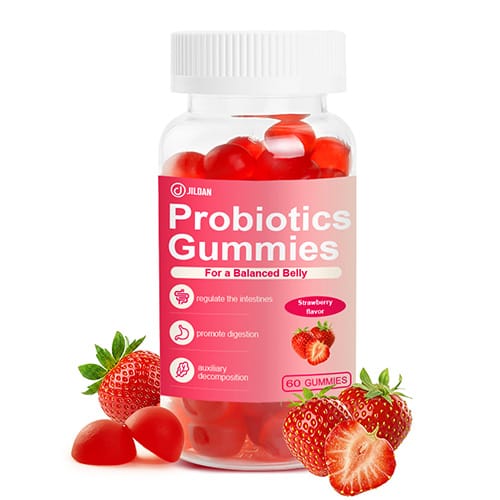
Many brands begin product development by choosing flavor, gummy shape, color, or packaging.
For private label probiotics gummies, that sequence should usually be reversed.
The microorganism comes first.
Each strain can have its own characteristics relating to:
- heat tolerance;
- moisture sensitivity;
- oxygen sensitivity;
- storage conditions;
- viable-count requirements;
- supporting research;
- compatibility with other ingredients.
NIH explains that probiotic identity includes the genus, species, and strain designation. Research involving one strain cannot automatically be generalized to another strain simply because the microorganisms belong to the same species.
This makes strain-level documentation particularly important.
Before asking a manufacturer for samples of private label probiotics gummies, brands should determine:
- which microorganism or microorganisms are proposed;
- the complete strain designation where applicable;
- why each strain is included;
- the target CFU per serving;
- the point in shelf life at which that CFU must be achieved;
- the recommended storage condition;
- whether the strain is technically compatible with gummy processing.
This approach prevents the product from becoming a generic gummy formula with an arbitrary probiotic powder added at the end.
Define CFU at the End of Shelf Life
CFU, or colony-forming units, describes viable microorganisms capable of forming colonies under specified test conditions.
It is one of the most familiar numbers associated with probiotics.
The challenge is that CFU can decline over time.
According to the NIH Probiotics Consumer Fact Sheet, some probiotic products state CFU at the time of manufacture, while others state the quantity expected through the expiration or use-by date. NIH specifically notes that microorganism counts can decline during shelf life, so the amount present at manufacturing does not necessarily represent the amount present when consumers use the product.
This distinction is critical for private label probiotics gummies.
Suppose a manufacturer adds a very high initial viable count but significant loss occurs during:
- gummy production;
- drying or conditioning;
- packaging;
- warehouse storage;
- shipping;
- consumer storage.
The impressive initial number may become commercially meaningless.
For this reason, a brand should define the CFU claim time point before finalizing the formula.
Ask:
- Is the CFU specification at manufacture or end of shelf life?
- What is the target at product release?
- What is the target at expiry?
- What overage is required?
- What stability data support that overage?
- Is CFU measured in the actual finished gummy?
A technically strong private label probiotics gummies project should answer these questions before commercial production begins.
More CFU Does Not Automatically Mean a Better Product
High numbers can be attractive in marketing, but probiotic quality should not become a competition over who can print the largest CFU number.
NIH reports that many probiotic dietary supplements contain approximately 1 billion to 10 billion CFU per dose, while some provide 50 billion CFU or more. NIH also explicitly states that higher CFU counts do not necessarily mean greater health benefits.
That is useful context for brands developing private label probiotics gummies.
The appropriate CFU depends on factors such as:
- strain;
- intended positioning;
- evidence;
- serving size;
- dosage form;
- stability.
A lower viable-count target with relevant evidence and strong end-of-shelf-life stability may create a much more defensible product than an extremely high CFU claim supported only on the day of manufacture.
Brands should therefore ask the manufacturer to explain the rationale behind the CFU target.
If the only answer is “consumers prefer a higher number,” the formulation strategy probably needs more work.
Gummy Manufacturing Creates Heat, Moisture, and pH Challenges
The biggest technical problem with private label probiotics gummies is that gummies can create conditions that living microorganisms do not naturally prefer.
The process can expose microorganisms to combinations of:
- heat;
- moisture;
- acidity;
- oxygen;
- mechanical processing.
These factors need to be considered together.
Heat
Traditional gummy processing can involve elevated temperatures.
A probiotic should therefore not simply be added at any convenient stage of production.
Brands should ask:
- At what stage is the probiotic introduced?
- What temperature will it experience?
- How long will that exposure last?
- What viability loss is expected during processing?
Moisture
A gummy contains more moisture than a conventional dry capsule.
This can make long-term viability more difficult for moisture-sensitive microorganisms.
The formula may therefore need tight control of:
- water activity;
- final moisture;
- packaging barrier;
- environmental humidity.
Acidity
Acids are commonly used in gummy formulation to manage flavor and gelling behavior.
But the final pH environment can influence microorganism survival.
Oxygen
Some microorganisms can be sensitive to oxygen exposure.
That means production, package headspace, closure quality, and package barrier properties can all become relevant.
A professional manufacturer of private label probiotics gummies should be able to explain how these variables have been considered for the selected strain.
Strain Stability Should Determine Whether a Gummy Is Technically Suitable
Not every probiotic strain belongs in a gummy.
That is an important product-development reality.
A brand may have excellent scientific reasons for selecting a particular microorganism, yet the strain may not tolerate the proposed gummy manufacturing process or storage environment.
In that situation, a capsule, powder, sachet, or another format may be technically superior.
Brands should therefore ask manufacturers of private label probiotics gummies for evidence specific to:
- the strain;
- the manufacturing process;
- the finished matrix;
- the package;
- the proposed shelf life.
Raw-material stability alone is not enough.
A microorganism can remain highly stable when stored as a dry ingredient in sealed supplier packaging but decline much faster once placed into a gummy containing moisture, acids, flavors, sweeteners, and other ingredients.
The commercial dosage form needs its own evidence.
Single-Strain vs Multi-Strain Private Label Probiotics Gummies
A multi-strain formula may look more sophisticated on a label, but adding strains also increases technical complexity.
Each microorganism can differ in:
- stability;
- required dose;
- evidence;
- manufacturing tolerance;
- analytical behavior.
NIH notes that probiotic dietary supplements can contain a single strain or multiple strains, but the benefits of commercial products can be difficult to predict because strain, dosage, and formulation vary substantially.
For private label probiotics gummies, a multi-strain product should therefore have a clear rationale.
Ask:
- Why is each strain included?
- Does the amount of each strain have a scientific basis?
- Can each strain survive the gummy process?
- Can each remain viable throughout shelf life?
- Can the testing method appropriately assess the finished blend?
One additional issue is that total CFU does not necessarily tell you how individual strains are performing.
If one strain declines quickly while another remains stable, the total viable count might still appear acceptable even though the intended strain balance has changed.
A carefully selected single strain can therefore be more technically transparent than a large multi-strain blend.
Should You Add Prebiotics to Private Label Probiotics Gummies?
Combining probiotics and prebiotics is another popular formulation strategy.
The NIH differentiates probiotics—live microorganisms—from prebiotics, which are substrates selectively used by microorganisms. Products combining both concepts may be described as synbiotic formulations when appropriately designed.
Adding a prebiotic to private label probiotics gummies can create a more differentiated product, but it also changes the formulation.
Depending on the ingredient and amount, prebiotics may influence:
- gummy solids;
- texture;
- sweetness;
- water activity;
- serving size;
- digestive tolerance.
This becomes especially important if the brand wants to include a substantial prebiotic quantity rather than a very small label-driven amount.
A formulation should therefore answer:
Does the prebiotic make the product meaningfully better, or does it simply make the Supplement Facts panel longer?
If the ingredient is included, its level should be technically realistic and consistent with the product’s intended positioning.
Pectin vs Gelatin for Private Label Probiotics Gummies
The gummy base also matters.
Pectin
Pectin can support plant-based and vegan product positioning.
However, pectin systems require careful management of:
- pH;
- solids;
- processing temperature;
- moisture;
- setting conditions.
For private label probiotics gummies, these parameters need to be evaluated alongside microorganism stability.
Gelatin
Gelatin offers different processing and texture characteristics.
It can create a softer, more elastic chew but does not fit vegan positioning.
The decision should not be made solely from marketing trends.
A manufacturer should evaluate:
- process temperature;
- microorganism addition stage;
- target texture;
- moisture;
- storage stability.
Brands considering gummy production can review JD Nutra’s gummy supplement manufacturing range to compare the format with other functional gummy concepts.
Sugar-Free Probiotic Gummies Need Separate Development
Sugar-free is another popular request in gummy manufacturing.
But removing sugar changes more than sweetness.
Sugar contributes to:
- solids;
- texture;
- water activity;
- processing behavior;
- shelf-life characteristics.
For private label probiotics gummies, those changes can also influence microbial stability.
Alternative sweeteners and bulking systems may create a different moisture environment from the conventional formula.
That means a manufacturer should not simply take an established probiotic gummy formula, remove sugar, and assume the same stability results still apply.
The revised product may require:
- new prototypes;
- updated moisture evaluation;
- new CFU stability work;
- sensory reassessment.
Sugar-free should therefore be part of the original RFQ whenever possible.
Packaging Is Part of Private Label Probiotics Gummies Formulation
Packaging decisions should happen earlier for probiotics than they do for many conventional supplements.
The package is part of the microorganism protection system.
Important factors can include:
- moisture transmission;
- oxygen transmission;
- closure integrity;
- package headspace;
- repeated consumer opening;
- light exposure;
- storage environment.
A finished bottle of private label probiotics gummies may be opened daily for weeks or months.
Each opening can expose the product to ambient air and humidity.
That makes commercial-use conditions relevant when evaluating shelf stability.
Ask potential manufacturers:
- Which package was used during stability work?
- Was a desiccant included?
- What storage conditions were evaluated?
- Can another package be substituted without new assessment?
A stability program conducted in one bottle does not automatically prove equivalent performance in a completely different container or pouch.
Shelf-Stable vs Refrigerated Products
Not every probiotic requires refrigeration.
NIH explains that some probiotic products need refrigerated storage while others can be stored at room temperature, and consumers should follow the product’s specific storage instructions.
For private label probiotics gummies, shelf-stable positioning can be commercially useful because it simplifies:
- ecommerce fulfillment;
- retail distribution;
- international transportation;
- consumer storage.
However, “shelf stable” should be demonstrated rather than assumed.
Ask for evidence connecting:
- selected strain;
- gummy formula;
- package;
- temperature;
- shelf-life period.
A shelf-stable raw material does not automatically create shelf-stable private label probiotics gummies.
Finished-Product Testing Should Measure the Actual Gummy
A raw-material COA tells you something about the probiotic ingredient before production.
It does not prove the finished gummy contains the same viable level after manufacturing.
The final product should therefore have defined specifications.
Depending on the formula, these may include:
- viable CFU;
- microorganism identity where appropriate;
- microbiological specifications;
- gummy weight;
- moisture or water-activity parameters;
- appearance;
- packaging integrity.
Brands sourcing private label probiotics gummies should ask:
- Is CFU tested after commercial manufacturing?
- Which method is used?
- What is the acceptance range?
- Is testing performed on the finished gummy?
- Does the COA report actual CFU results?
- Is CFU monitored again during stability?
This creates a direct connection between the label claim and the product consumers actually receive.
FDA Labeling Requires Special Attention for Live Microbials
Live microbial dietary ingredients create unusual labeling considerations because microorganisms can be described both by weight and viable count.
FDA issued draft guidance explaining the conditions under which it intends to exercise enforcement discretion to allow dietary supplements containing live microbial ingredients to declare CFU in addition to the quantitative amount by weight required by regulation.
Brands can review the official FDA guidance information on live microbial labeling.
Because that document remains draft guidance, brands should not treat it as a final standalone regulation.
For private label probiotics gummies, the label should be reviewed for:
- strain identification;
- serving size;
- quantitative declaration;
- CFU statement where used;
- storage instructions;
- expiration or use-by information;
- ingredient statement.
Artwork should not be finalized before the strain, CFU strategy, serving size, and stability basis are established.
Quality Control Should Follow 21 CFR Part 111
For dietary supplements marketed in the United States, manufacturing needs to be evaluated within the applicable dietary supplement CGMP framework.
FDA’s Current Good Manufacturing Practice requirements under 21 CFR Part 111 address areas including:
- specifications;
- component controls;
- manufacturing;
- quality control;
- packaging;
- labeling;
- records.
A manufacturer of private label probiotics gummies should therefore be able to describe how the probiotic product moves through its quality system.
Important questions include:
- How are raw materials approved?
- How is microorganism identity handled?
- How are specifications established?
- How are production deviations investigated?
- Who reviews finished-product results?
- Who releases the batch?
Brands can consult the official FDA Dietary Supplement CGMP Compliance Guide when building a manufacturer audit checklist.
What Should a Probiotic Gummy COA Include?
A representative COA can reveal a great deal about the quality system behind private label probiotics gummies.
Depending on the agreed specification, useful information may include:
- product identification;
- lot number;
- viable-count specification;
- actual CFU result;
- analytical method;
- microbiological specifications;
- physical requirements;
- test date;
- quality approval.
The buyer should determine whether the COA applies to:
- probiotic raw material;
- bulk gummy;
- finished gummy;
- packaged finished product.
Those documents are not interchangeable.
For a live microbial product, a finished-product CFU result can be particularly valuable because it captures viability after the manufacturing process rather than before it.
Stock Formula or Custom Private Label Probiotics Gummies?
Both routes can make sense.
Stock Formula
An existing private label probiotics gummies formula may be appropriate when the brand prioritizes a simpler product-development path.
Potential benefits include:
- established formulation;
- known manufacturing process;
- existing flavor system;
- fewer development variables.
However, brands should still verify:
- strains;
- CFU time point;
- stability basis;
- package;
- testing.
“Stock” should not mean that technical questions are unnecessary.
Custom Formula
Custom private label probiotics gummies provide greater control over:
- strain selection;
- CFU target;
- prebiotic ingredients;
- gummy base;
- sweetener system;
- flavor;
- serving size.
The trade-off is greater technical complexity.
A custom formula may require additional:
- feasibility work;
- sample development;
- stability planning;
- testing;
- packaging assessment.
The choice should be based on product strategy rather than the assumption that custom is always better.
MOQ Should Not Be the First Supplier Question
Minimum order quantity is commercially important, but it should come after technical feasibility.
A manufacturer may offer an attractive MOQ while the proposed strain or CFU target remains poorly matched to the gummy platform.
When discussing MOQ for private label probiotics gummies, clarify whether it covers:
- finished units;
- production batch size;
- custom probiotic material;
- custom flavor;
- bottle or pouch;
- printed packaging.
Then look beyond the first order.
Ask:
- Can the same strains be sourced consistently?
- Can CFU specifications remain the same as volume grows?
- Can the package remain unchanged?
- How is repeat production planned?
- What changes require brand approval?
The right supplier should support both initial launch and future scale.
Samples Need More Than a Taste Test
A probiotic gummy sample may look and taste excellent but still fail its most important technical requirement: maintaining viable microorganisms.
Brands evaluating private label probiotics gummies should assess samples on two levels.
Consumer Experience
Check:
- flavor;
- aroma;
- texture;
- sweetness;
- acidity;
- appearance.
Technical Performance
Confirm:
- strain;
- CFU target;
- actual probiotic material;
- manufacturing process;
- package;
- stability basis.
Ask whether the sample uses the same probiotic ingredient intended for commercial production.
If a substitute is used during early development, that should be clearly disclosed.
A flavor-approved gummy made with a technically different microorganism does not fully represent the commercial product.
How to Audit a Private Label Probiotics Gummies Manufacturer
A manufacturer audit should focus on probiotic-specific capability rather than general gummy experience alone.
Strain Qualification
Ask:
- Which strains can be supported?
- How are strain identities documented?
- How are probiotic suppliers qualified?
Manufacturing Process
Ask:
- When is the probiotic added?
- What heat exposure occurs?
- How is moisture controlled?
CFU Strategy
Ask:
- What is the release CFU?
- What is the end-of-shelf-life target?
- How is overage calculated?
Stability
Ask:
- Is the commercial package tested?
- Which conditions are used?
- How many time points are evaluated?
Quality
Ask:
- What finished-product testing is performed?
- What does the COA report?
- How are deviations handled?
Change Control
Ask:
- Can the strain source change without approval?
- Can packaging change?
- What happens if a raw material becomes unavailable?
This level of review is essential because private label probiotics gummies require both gummy-manufacturing capability and live-microbial expertise.
What to Include in Your RFQ
A strong RFQ should define the product before asking for commercial terms.
For private label probiotics gummies, include:
Target Consumer
Define:
- adult;
- family;
- another relevant audience.
Probiotic Requirements
Specify:
- genus;
- species;
- strain;
- target CFU;
- end-of-shelf-life requirement.
Gummy Format
Define:
- pectin or gelatin;
- serving size;
- gummy weight;
- flavor;
- sugar strategy;
- vegan requirements.
Additional Ingredients
List any:
- prebiotics;
- vitamins;
- minerals;
- other ingredients.
Stability Requirements
State:
- intended shelf life;
- room-temperature or refrigerated storage;
- target markets.
Testing
Request:
- finished-product CFU testing;
- appropriate microbiological specifications;
- COA;
- stability information.
Packaging
Define:
- bottle or pouch;
- count;
- closure;
- label;
- carton where relevant.
Brands can review JD Nutra’s existing article on probiotics gummies and digestive wellness product development before preparing the brief.
For formulation, manufacturing, testing, and packaging support, review JD Nutra’s supplement CDMO services.
Common Mistakes Brands Make With Private Label Probiotics Gummies
Choosing CFU Before Choosing the Strain
CFU should be tied to a defined microorganism and product concept.
Promising CFU Only at Manufacture
A day-one number does not tell consumers what remains later.
Selecting Gummies Before Confirming Strain Stability
Not every microorganism is appropriate for the gummy process.
Using Raw-Material Data as Finished-Product Evidence
Commercial private label probiotics gummies need product-specific verification.
Adding Too Many Strains
A longer label can make stability and evidence harder to manage.
Ignoring Packaging
Moisture and oxygen protection can affect viability.
Treating Sugar-Free as a Small Formula Change
Changing the gummy matrix can change microorganism stability.
Choosing a Manufacturer Only by MOQ
A low MOQ cannot compensate for weak stability or quality controls.
Finalizing Artwork Before Stability Strategy
The CFU claim, storage statement, and serving information need to match the finished product.
FAQ
What are private label probiotics gummies?
Private label probiotics gummies are gummy dietary supplements manufactured by a third-party producer and sold under another company’s brand. Depending on the supplier, brands may select an existing formula or develop a customized probiotic gummy.
How many CFU should private label probiotics gummies contain?
There is no universal ideal number.
The appropriate CFU depends on strain, evidence, product design, and end-of-shelf-life viability. NIH notes that higher CFU counts are not automatically associated with greater benefits.
Should CFU be guaranteed through shelf life?
For a quality-focused product, brands should strongly consider how many viable microorganisms remain through the intended shelf life rather than relying only on the amount measured at manufacture. NIH notes that CFU can decline over time.
Can private label probiotics gummies be shelf stable?
Potentially, depending on the strain, formulation, process, packaging, and storage conditions.
Shelf stability should be supported by evidence from the finished commercial product.
Can private label probiotics gummies contain multiple strains?
Yes, when each strain has a clear rationale and can meet the required stability specifications.
Multi-strain products require additional consideration because strains may decline at different rates.
Can private label probiotics gummies include prebiotics?
Yes.
Prebiotics can be incorporated when they fit the product concept and formulation, but they can affect serving size, texture, water activity, and stability.
Should probiotic gummies use pectin or gelatin?
Either can be technically possible. The appropriate choice depends on processing conditions, target texture, dietary positioning, microorganism stability, and manufacturing capability.
What should brands ask a probiotic gummy manufacturer first?
Ask which strain will be used and whether the manufacturer can demonstrate that the finished private label probiotics gummies maintain the intended viable CFU through the proposed shelf life in the actual commercial package.
Conclusion
Successful private label probiotics gummies are built around viability rather than marketing numbers.
A strong project begins with a clearly identified microorganism, a scientifically reasonable CFU target, and a definition of how many viable cells need to remain at the end of shelf life.
From there, every major product decision becomes connected:
- strain selection;
- processing temperature;
- moisture;
- gummy base;
- prebiotics;
- packaging;
- storage;
- testing;
- labeling.
This is what makes private label probiotics gummies fundamentally different from conventional vitamin gummies.
The active ingredients are alive.
A product that contains a high CFU count on manufacturing day but cannot maintain that count through storage is not equivalent to one designed around end-of-shelf-life viability.
For supplement brands, the strongest manufacturing partner is therefore not simply the supplier that can make gummies.
It is the manufacturer that can explain how the microorganism is identified, how the strain survives the process, how CFU is controlled, how the package protects the product, and how the final claim is supported through shelf-life data.
Brands researching the category can first review JD Nutra’s Probiotics Gummies market and formulation article and explore its broader gummy supplement manufacturing range.
For brands comparing gummies with other delivery systems, JD Nutra’s capsule supplement manufacturing range provides an alternative format to evaluate for more sensitive strains.
When your strain, CFU target, gummy base, shelf-life requirement, packaging, and destination market are defined, contact JD Nutra to discuss the technical feasibility of your private label probiotics gummies project.


