
Launching private label folic acid gummies can look relatively simple compared with developing high-dose mineral gummies or complex botanical formulas. Folic acid is used in microgram quantities, so the active ingredient itself takes up very little physical space inside a gummy.
That apparent simplicity can be misleading.
A commercial product still needs the correct folate form, accurate low-dose mixing, appropriate serving design, U.S. Dietary Folate Equivalent labeling where applicable, stable vitamin potency, suitable gummy processing, quality testing, packaging, and claims that match the intended consumer.
Folic acid also carries an unusually important public-health context. The CDC currently recommends that all women capable of becoming pregnant get 400 mcg of folic acid every day to help prevent neural tube defects. CDC emphasizes that these birth defects develop very early in pregnancy, often before a person knows they are pregnant.
For brands sourcing private label folic acid gummies, that evidence creates opportunity—but it also creates responsibility.
The best product-development question is not simply:
“How quickly can we put folic acid into a gummy?”
It is:
“Can we create a product with the right folic acid form, accurate dose, reliable potency, appropriate labeling, consumer-friendly format, and a manufacturing system that reproduces the same specification batch after batch?”
Start Private Label Folic Acid Gummies With the Target Consumer
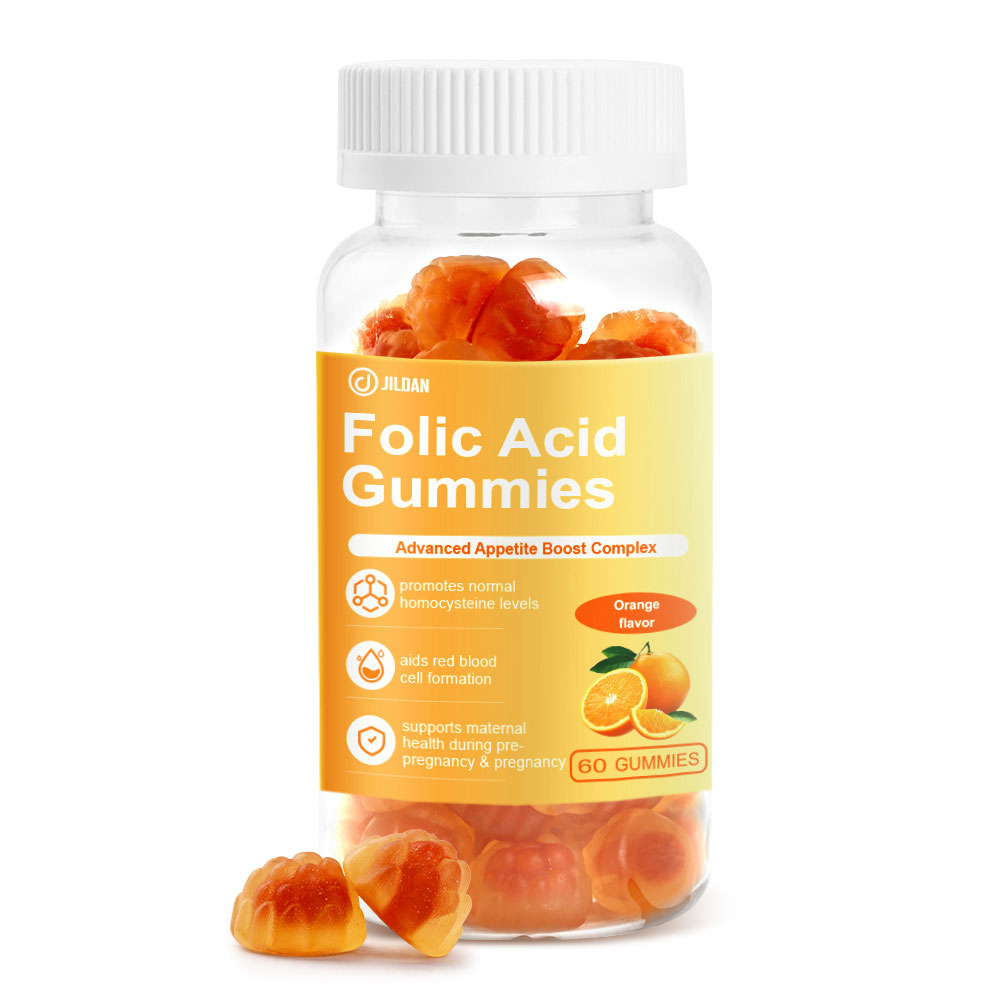
Before choosing flavor, gummy shape, bottle size, or supporting ingredients, define who the product is for.
Private label folic acid gummies can be developed for several different positions:
- general vitamin B9 supplementation;
- women’s daily wellness;
- women capable of becoming pregnant;
- broader women’s multivitamin products;
- B-vitamin formulas;
- prenatal-oriented product lines developed with appropriate nutritional and regulatory review.
These are not identical concepts.
A simple folic acid gummy may contain one primary nutrient and have a straightforward educational message.
A women’s wellness formula may combine folic acid with nutrients such as vitamin B12, vitamin B6, iodine, vitamin D, or other carefully selected ingredients.
A prenatal-oriented product requires a much broader nutritional strategy because pregnancy nutrition is not defined by folic acid alone.
This is why private label folic acid gummies should begin with audience definition rather than ingredient stacking.
The target consumer influences:
- folic acid amount;
- supporting nutrients;
- serving size;
- warnings;
- claims;
- packaging;
- educational content.
Brands that need deeper technical background before selecting a commercial formula can review JD Nutra’s existing Folic Acid Gummies Formulation Guide.
Folic Acid and Folate Should Not Be Treated as Identical Terms
One of the first technical distinctions in private label folic acid gummies development is the difference between folate and folic acid.
Folate is the broad term for vitamin B9 compounds.
Folic acid is a specific form used in dietary supplements and fortified foods.
The FDA explains that folate occurs naturally in foods, while folic acid is used in fortified foods and certain dietary supplements.
The CDC further states that folic acid is the form of folate demonstrated to help prevent neural tube defects.
This matters because a manufacturer may offer several ingredient options, including:
- folic acid;
- methylfolate;
- 5-MTHF;
- other folate forms.
They should not automatically be treated as interchangeable.
When requesting private label folic acid gummies, brands should specify:
- exact nutrient form;
- raw-material potency;
- target amount per serving;
- required documentation;
- intended market;
- intended claims.
If the product is specifically positioned around the CDC folic acid recommendation, the ingredient choice needs to align with that evidence.
Understand mcg DFE Before Approving the Supplement Facts Panel
Dietary Folate Equivalents are one of the most important labeling considerations in a U.S. folic acid project.
FDA requires folate to be declared in mcg DFE on Nutrition Facts and Supplement Facts labels because the body absorbs folic acid differently from naturally occurring food folate.
When folic acid is added, its actual quantity must also be shown in parentheses.
FDA’s current Daily Value for folate is 400 mcg DFE for most adults, while pregnancy and breastfeeding use different reference values. FDA explains the full declaration system here.
This means private label folic acid gummies should not move to artwork based only on a raw-material quotation.
The development team needs to align:
- folic acid input;
- folate in mcg DFE;
- actual folic acid in parentheses;
- percentage Daily Value;
- gummies per serving.
A small formulation change can alter the label.
For brands selling into the U.S. market, DFE calculations should therefore be part of formulation review rather than a last-minute artwork task.
Low Active Loading Creates a Uniformity Challenge
Folic acid has one useful formulation advantage: it does not require hundreds of milligrams or several grams per serving.
However, that creates a different technical challenge.
A microgram-level active needs to be distributed uniformly throughout a commercial gummy batch that may contain many kilograms of other ingredients.
For private label folic acid gummies, manufacturers need to control how the active is introduced into the batch.
This may involve:
- preparing an appropriate premix;
- using a suitable carrier;
- controlling ingredient addition sequence;
- defining mixing time;
- sampling the batch appropriately;
- confirming finished-product potency.
The fact that folic acid easily fits physically into a gummy does not mean low-dose manufacturing is automatically easy.
A good manufacturer should be able to explain how it prevents uneven distribution.
Useful buyer questions include:
- Is folic acid added directly or through a premix?
- How is the premix prepared?
- How is blend uniformity monitored?
- Is finished-product potency tested?
- How is batch variation handled?
This is one of the most important quality questions in private label folic acid gummies sourcing.
Decide Whether You Need a Stock Formula or Custom Formula
Brands generally have two basic sourcing routes.
Stock Private Label Formula
A stock formula can make sense when the existing nutrient profile already fits the intended product.
Potential advantages include:
- established formulation;
- known gummy process;
- fewer development variables;
- simpler sampling;
- existing stability experience.
Even with an existing formula, buyers should still confirm:
- folic acid form;
- amount;
- DFE declaration;
- gummy base;
- sugar system;
- testing;
- packaging.
“Stock” does not mean technical review is unnecessary.
Custom Formula
Custom private label folic acid gummies provide more control over:
- folic acid amount;
- additional nutrients;
- gummy base;
- flavor;
- color;
- serving size;
- sweetener system;
- packaging.
The trade-off is more development work.
A customized project may require:
- technical feasibility review;
- ingredient sourcing;
- prototypes;
- stability planning;
- additional testing.
The right choice depends on whether customization creates a meaningful consumer or commercial advantage.
A 400 mcg Folic Acid Concept Needs Careful Label Interpretation
The 400 mcg number is widely recognized because CDC recommends that women capable of becoming pregnant get 400 mcg of folic acid each day.
However, brands developing private label folic acid gummies need to distinguish between the amount of folic acid itself and the folate quantity declared as mcg DFE on a U.S. Supplement Facts panel.
Those values are not necessarily displayed identically.
This is one reason manufacturers, regulatory reviewers, and packaging teams should coordinate before final printing.
Brands should avoid situations where:
- the marketing panel says one amount;
- the Supplement Facts panel communicates another number without context;
- consumer-facing copy creates confusion between folate and folic acid.
Clear labeling is especially important because consumers may be looking specifically for the CDC-recommended amount of folic acid.
The brand should make it easy to understand what the product actually provides.
Folic Acid Gummies Do Not Automatically Equal a Prenatal Vitamin
Because folic acid is strongly associated with pregnancy planning, it can be tempting to position all private label folic acid gummies as prenatal products.
That can be misleading.
A complete prenatal product generally involves a broader nutritional profile than folic acid alone.
A standalone folic acid gummy may instead be positioned around:
- vitamin B9 supplementation;
- women’s daily nutrition;
- preconception folic acid intake.
The CDC recommends starting adequate folic acid intake before pregnancy because neural tube development happens very early.
That evidence can be communicated accurately without implying that a folic acid-only supplement replaces a complete prenatal nutrition strategy.
For private label folic acid gummies, accurate positioning is usually more credible than trying to expand the product into claims it was not designed to support.
Adding Vitamin B12 Can Create a More Complete B-Vitamin Concept
Vitamin B12 is one of the most common nutrients considered alongside folate.
A combination can make sense when the product concept supports broader B-vitamin nutrition.
However, adding B12 changes the specification.
The manufacturer needs to define:
- B12 form;
- amount;
- potency;
- stability;
- premixing;
- finished-product testing.
Both folic acid and vitamin B12 can be present at low quantities, making uniform distribution particularly important.
A custom private label folic acid gummies project may therefore use folic acid as the hero nutrient while including B12 as a supporting component.
The key is formulation logic.
Brands should not add nutrients simply because consumers recognize them.
Every ingredient should support the product concept and remain technically manageable.
Iron Changes Folic Acid Gummies Into a More Complex Product
Iron is frequently associated with women’s nutrition, but it dramatically changes gummy formulation.
Folic acid has a very low active mass.
Iron can require a much larger raw-material quantity.
It can also contribute:
- metallic taste;
- color changes;
- oxidation concerns;
- additional safety considerations;
- higher active loading.
For this reason, private label folic acid gummies with iron should be treated as a separate product-development project rather than a minor variation.
Brands need to consider:
- iron form;
- elemental iron amount;
- target consumer;
- flavor masking;
- texture;
- finished-product testing;
- labeling.
A focused folic acid-and-B12 formula may be technically simpler than attempting to turn one gummy into a complete high-mineral women’s supplement.
Product developers should be willing to keep the formula narrow when that produces a better finished product.
Pectin vs Gelatin Should Be Decided Early
The gummy base influences product positioning and manufacturing behavior.
Pectin
Pectin-based private label folic acid gummies can support vegetarian and vegan product strategies when the entire ingredient system meets the required criteria.
Pectin formulations require controlled:
- pH;
- soluble solids;
- temperature;
- moisture;
- setting conditions.
Gelatin
Gelatin creates a different chew and processing profile.
It may suit products where vegan positioning is not required.
Because folic acid itself requires very little physical space, the choice between pectin and gelatin is usually determined more by:
- brand strategy;
- texture target;
- supporting ingredients;
- manufacturing platform.
Brands exploring the wider category can review JD Nutra’s gummy supplement manufacturing range.
Sugar-Free Private Label Folic Acid Gummies Need Separate Development
Sugar-free is attractive to many supplement brands, but it should not be treated as an easy conversion.
Sugar contributes to more than sweetness.
In gummy manufacturing it can influence:
- solids;
- texture;
- water activity;
- processing;
- flavor;
- shelf stability.
A sugar-free version may require:
- alternative sweeteners;
- bulking agents;
- revised gummy processing;
- new stability assessment.
For private label folic acid gummies, the relatively mild sensory burden of the active ingredient can make sugar-free development easier than it would be for strongly bitter botanicals.
However, the gummy matrix still changes.
A manufacturer should therefore test the actual sugar-free system rather than relying on stability data from a conventional formula.
Flavor Should Match the Consumer and Product Position
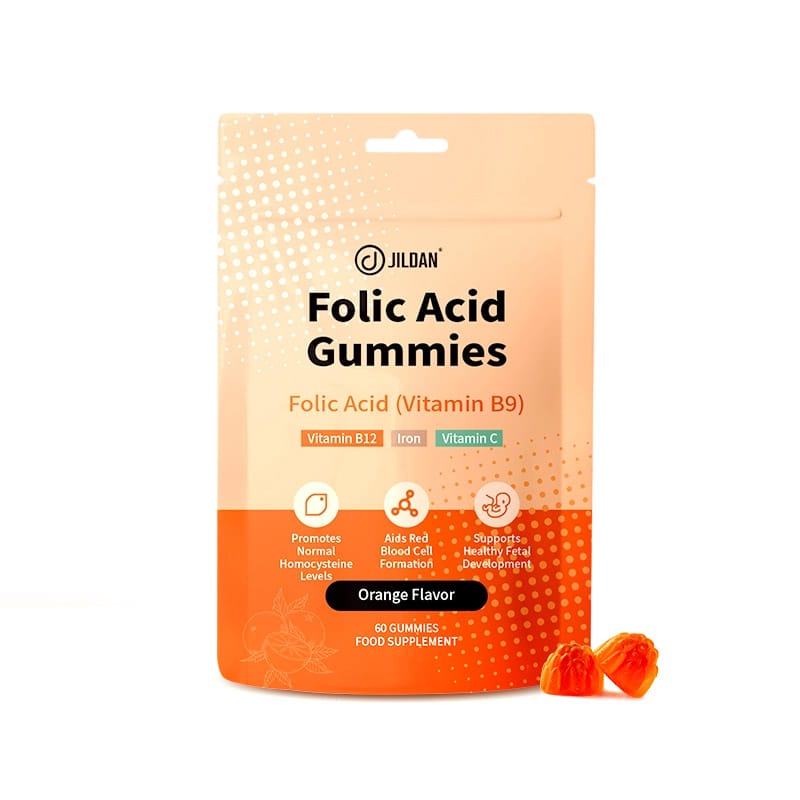
Because folic acid itself is used at a very low level, flavor development for private label folic acid gummies can be more flexible than for gummies containing high loads of bitter extracts.
Possible directions include:
- berry;
- strawberry;
- raspberry;
- orange;
- peach;
- tropical fruit.
Flavor should still be selected after all major supporting nutrients are added.
Vitamin B12, iron, iodine, zinc, or other ingredients can alter the sensory profile.
A prototype without the final active system may taste very different from the commercial formula.
Brands should therefore approve samples that are technically representative of the product they intend to sell.
Stability Should Verify Both Potency and Gummy Quality
The small amount of folic acid in the formula does not eliminate the need for stability planning.
A commercial product needs to maintain:
- folic acid potency;
- texture;
- appearance;
- flavor;
- microbiological quality;
- packaging performance
throughout its intended shelf life.
CDC notes that folic acid is more stable than naturally occurring food folates, which is one reason it is used in fortified foods and supplements. CDC’s clinician guidance provides additional context.
That does not mean every gummy formula automatically remains stable.
Processing, moisture, additional nutrients, packaging, and storage can still affect the finished product.
When sourcing private label folic acid gummies, ask:
- How is shelf life established?
- Is folic acid potency monitored?
- Is the actual commercial package tested?
- Are gummy texture and moisture evaluated?
- Is an overage used?
The manufacturer should have a technical rationale for the intended shelf life.
Nutrient Overages Should Be Justified
Some vitamin formulas use an intentional overage to compensate for expected manufacturing or storage losses.
That does not mean more is always better.
With private label folic acid gummies, the overage strategy should reflect:
- folic acid stability;
- manufacturing process;
- intended shelf life;
- package;
- actual stability data.
This becomes particularly important because there is an established Tolerable Upper Intake Level for synthetic folate from supplements and fortified foods.
The NIH Office of Dietary Supplements explains that the adult UL for synthetic forms of folate from supplements and fortified foods is 1,000 mcg per day for adults, while different limits apply to younger age groups. The UL does not apply when high-dose folate is used under medical supervision.
That figure should not be interpreted as a target dosage.
It illustrates why vitamin overages need to be controlled rather than arbitrarily maximized.
Finished-Product Testing Should Confirm What Consumers Receive
Raw-material calculations are not a substitute for finished-product quality control.
Commercial production introduces:
- weighing;
- premixing;
- gummy processing;
- depositing;
- drying or conditioning;
- packaging.
A specification for private label folic acid gummies may therefore address:
- appearance;
- gummy weight;
- folic acid or folate potency;
- microbiological quality;
- relevant contaminant limits;
- moisture-related characteristics;
- package integrity.
The manufacturer should also be able to provide a representative finished-product COA.
Ask:
- Is potency measured on the finished gummy?
- Which method is used?
- What acceptance range applies?
- Are actual results reported?
- Who reviews and releases the batch?
A small active dose makes this confirmation especially important.
U.S. Manufacturing Should Follow Dietary Supplement CGMP Requirements
For dietary supplements marketed in the United States, the manufacturing process needs to be evaluated within FDA’s dietary supplement Current Good Manufacturing Practice framework.
The FDA CGMP compliance guidance addresses areas including:
- specifications;
- component controls;
- manufacturing;
- quality control;
- packaging;
- labeling;
- batch records.
A manufacturer of private label folic acid gummies should be able to explain how:
- ingredients are qualified;
- raw materials are released;
- low-dose nutrients are controlled;
- production deviations are handled;
- finished-product specifications are verified;
- batches are released.
Certification logos alone do not answer these questions.
The quality system needs to work at the product level.
Packaging Should Protect the Gummy and Communicate the Product Clearly
Packaging for private label folic acid gummies should perform two jobs.
First, it protects the finished gummy.
Second, it helps consumers understand the product.
Technical considerations can include:
- moisture barrier;
- closure integrity;
- repeated opening;
- gummy count;
- headspace;
- shipping environment.
Communication considerations include:
- serving size;
- folate declaration;
- folic acid amount;
- target audience;
- appropriate warnings.
The commercial package should ideally be included in stability assessment.
Switching package formats after stability work has been completed can change the product environment.
For brands selling through ecommerce, shipping conditions should also be considered because gummies may experience temperature variation before reaching the consumer.
Health Claims Should Stay Close to the Evidence
Folic acid has a strong public-health evidence base—but that does not mean a brand can make unlimited health claims.
The strongest established message relates to adequate folic acid intake among people capable of becoming pregnant and reduction of neural tube defect risk.
Brands should not turn private label folic acid gummies into claims that they:
- guarantee a healthy pregnancy;
- prevent all birth defects;
- treat infertility;
- replace prenatal medical care.
For broader advertising, the FTC Health Products Compliance Guidance states that health-related advertising must be truthful, not misleading, and appropriately substantiated, generally with competent and reliable scientific evidence.
This is important for product pages, paid advertising, social media, and influencer content—not only the physical label.
A strong marketing strategy uses the evidence accurately rather than stretching it.
Do Not Use “Best Folic Acid Gummies” Claims Without a Defensible Basis
Superlatives can create unnecessary marketing risk.
Words such as:
- best;
- highest quality;
- superior;
- most effective
require a basis that may be difficult to establish across an entire market.
For private label folic acid gummies, it is usually more useful to differentiate through verifiable characteristics such as:
- defined nutrient form;
- clearly stated serving;
- vegan pectin format;
- sugar-free formula;
- finished-product potency testing;
- transparent labeling.
These characteristics give buyers and consumers information they can actually evaluate.
They are also easier to support than vague superiority claims.
MOQ Should Be Evaluated Alongside Formula and Packaging
MOQ matters, but it should not be the first or only sourcing criterion.
The minimum requirement for private label folic acid gummies can depend on:
- stock vs custom formula;
- pectin vs gelatin;
- sugar system;
- flavor;
- supporting nutrients;
- bottle;
- label;
- carton.
Brands should ask exactly what the quoted MOQ includes.
Useful questions include:
- Is it based on gummies, bottles, or one production batch?
- Does a custom flavor change the requirement?
- Does custom packaging have a separate minimum?
- Are stock and custom formulas treated differently?
- What happens to unused packaging materials?
- How does repeat-order planning work?
The goal is not simply to find the smallest first order.
It is to build a supply model that can scale after the launch succeeds.
Samples Should Use the Intended Commercial Formula
A gummy sample can look excellent while failing to represent the final product.
When approving samples of private label folic acid gummies, confirm whether they contain:
- the intended folic acid form;
- intended folic acid amount;
- final supporting nutrients;
- final gummy base;
- final sweetener system;
- intended flavor.
If substitute ingredients are used during early development, that should be disclosed.
A flavor-approved blank gummy is not the same as a final nutrient-containing gummy.
Brands should evaluate:
- flavor;
- sweetness;
- acidity;
- texture;
- appearance;
- gummy size;
- serving count.
An approved reference sample can also be useful when reviewing future production batches.
How to Audit a Private Label Folic Acid Gummies Manufacturer
A structured qualification process makes supplier comparisons easier.
Nutrient Expertise
Ask:
- Which folic acid material is used?
- How is potency controlled?
- How is mcg DFE information calculated?
Low-Dose Manufacturing
Ask:
- How is folic acid premixed?
- How is uniformity managed?
- Is finished potency verified?
Gummy Capability
Ask:
- Is pectin available?
- Is gelatin available?
- Can sugar-free formulas be developed?
- Can custom flavors and shapes be supported?
Stability
Ask:
- How is shelf life established?
- What is tested during stability?
- Is final packaging included?
Quality Control
Ask:
- What appears on the finished-product COA?
- Which specifications are verified?
- Who releases each batch?
Regulatory Support
Ask:
- Can U.S. DFE labeling information be supplied?
- Can target-market requirements be considered during development?
Scale
Ask:
- Can the formula remain consistent as volume increases?
- How are repeat orders managed?
A professional supplier of private label folic acid gummies should be able to address both gummy manufacturing and micronutrient control.
What to Include in Your RFQ
A detailed RFQ makes quotations easier to compare.
For private label folic acid gummies, include:
Target Consumer
Define whether the product is intended for:
- general adults;
- women capable of becoming pregnant;
- women’s daily wellness;
- another defined group.
Nutrient Specification
Provide:
- folic acid form;
- target amount;
- DFE expectations;
- supporting nutrients.
Gummy Requirements
Specify:
- pectin or gelatin;
- gummy weight;
- gummies per serving;
- flavor;
- color;
- sugar strategy;
- vegan requirements.
Quality
Define:
- raw-material requirements;
- finished-product potency;
- microbiological requirements;
- COA;
- stability expectations.
Packaging
Include:
- bottle or pouch;
- gummy count;
- label;
- carton;
- destination market.
Commercial Requirements
Provide:
- initial order expectations;
- repeat-order forecast;
- sample requirements;
- intended launch timing.
Brands can review JD Nutra’s gummy supplement manufacturing capabilities and custom supplement CDMO services before preparing the final project brief.
When the product requirements are ready, contact JD Nutra to discuss formulation, testing, packaging, and commercial manufacturing.
Common Mistakes Brands Make With Private Label Folic Acid Gummies
Choosing Packaging Before Finalizing the Formula
Serving size and packaging should follow the approved product.
Confusing Folic Acid With Every Other Folate Form
Ingredient selection should match the evidence and intended positioning.
Ignoring DFE Labeling
U.S. folate declaration uses mcg DFE, with folic acid shown separately where applicable.
Assuming Microgram-Level Formulation Is Easy
Low-dose actives require careful premixing and uniformity control.
Automatically Calling the Product Prenatal
A standalone folic acid gummy is not automatically a complete prenatal supplement.
Adding Iron Without a Clear Strategy
Iron changes taste, active loading, safety considerations, and testing.
Treating Sugar-Free as a Minor Change
The gummy matrix and stability can change substantially.
Selecting a Supplier Only by MOQ
Manufacturing accuracy and repeat-batch consistency matter more over the life of the product.
FAQ
What Are Private Label Folic Acid Gummies?
Private label folic acid gummies are chewable vitamin B9 dietary supplements manufactured by a third-party producer and sold under another company’s brand.
They may use a standard existing formula or a customized nutrient, flavor, gummy-base, and packaging specification.
How Much Folic Acid Should Private Label Folic Acid Gummies Contain?
There is no universal commercial formula for every audience.
For women capable of becoming pregnant, CDC recommends 400 mcg of folic acid per day to help prevent neural tube defects.
The finished product should still be designed around the intended consumer, total formula, market, and appropriate professional review.
Why Does the Label Show mcg DFE?
FDA uses Dietary Folate Equivalents to account for differences in folate bioavailability.
When folic acid is added to a U.S. dietary supplement, the folate amount is declared in mcg DFE and the folic acid amount is also shown in parentheses.
Can Private Label Folic Acid Gummies Be Vegan?
Yes.
Pectin-based private label folic acid gummies can support vegan positioning when the other active and inactive ingredients also meet the relevant requirements.
Can Private Label Folic Acid Gummies Be Sugar-Free?
Yes, but sugar-free gummies require their own formulation strategy because changing sweeteners and bulking ingredients can affect texture, water activity, processing, and shelf stability.
Can Folic Acid Gummies Include Vitamin B12?
Yes.
Vitamin B12 can be incorporated when it fits the product concept, but its form, amount, stability, low-dose distribution, and finished-product testing should be defined.
Are Private Label Folic Acid Gummies the Same as Prenatal Gummies?
Not necessarily.
A folic acid product may support folic acid intake without providing the broader nutrient profile associated with a complete prenatal formula.
What Should I Ask a Folic Acid Gummies Manufacturer First?
Ask how the manufacturer controls low-dose folic acid distribution and whether the finished private label folic acid gummies are tested to verify the approved potency and label specification.
Conclusion
Developing private label folic acid gummies requires more technical discipline than the small active amount might suggest.
Folic acid itself takes up very little physical space inside a gummy. The larger challenges involve accurate low-dose mixing, appropriate nutrient form, DFE labeling, finished-product potency, stability, claims, and repeatable manufacturing.
For brands targeting women capable of becoming pregnant, the product also sits within a clear public-health context: the CDC recommends 400 mcg of folic acid daily to help prevent neural tube defects.
That evidence makes accuracy especially important.
A strong private label folic acid gummies project should therefore be built around:
- a defined target consumer;
- correct folic acid specification;
- accurate mcg DFE labeling;
- controlled premixing and uniformity;
- suitable gummy technology;
- validated finished-product potency;
- stability in the commercial package;
- evidence-aligned marketing.
Brands should also resist unnecessary complexity.
A focused folic acid product with transparent labeling and controlled manufacturing can be more credible than a crowded formula containing numerous supporting nutrients primarily for marketing purposes.
For technical formulation background, read JD Nutra’s existing Folic Acid Gummies Formulation Guide. Brands developing broader women’s vitamin concepts can also review JD Nutra’s Women Multivitamin Gummies.
To compare available formats and manufacturing options, explore the gummy supplement range and custom supplement manufacturing services.
When your folic acid target, gummy base, supporting nutrients, testing requirements, packaging, and destination market are ready, contact JD Nutra to discuss a private label folic acid gummies project.


