
Multivitamin-Gummis für Kinder sit in one of the most demanding areas of gummy supplement development because the product has to satisfy two very different audiences at the same time.
Children need an age-appropriate nutritional formula that can be manufactured and used safely. Parents need a product they can understand, trust, store appropriately, and fit into an existing diet without accidentally creating excessive nutrient intake.
For supplement brands, this means successful Kinder Multivitamin-Muschis should not be created by shrinking an adult gummy, lowering a few numbers on the Supplement Facts panel, and changing the packaging to brighter colors.
Children have different nutrient requirements at different ages. The physical limitations of gummies also affect which vitamins and minerals can be delivered in useful amounts. Some nutrients are sensitive to heat, moisture, oxygen, or light, while minerals can create bitterness, metallic flavors, texture problems, or excessive active loading.
The U.S. NIH Office of Dietary Supplements notes that multivitamin/mineral products for children typically provide nutrient amounts designed for younger age groups rather than simply mirroring adult formulations. NIH also reports that about one-quarter of U.S. children and adolescents use a multivitamin or multivitamin/mineral supplement.
That combination of widespread use and age-specific nutritional requirements makes formulation discipline especially important.
The right product-development question is therefore not:
“How many vitamins can we fit into kids multivitamin gummies?”
Es ist:
“Which nutrients make sense for this age group, in which forms and amounts, and can the finished gummy maintain those specifications safely and consistently through shelf life?”
Inhaltsverzeichnis
Kids Multivitamin Gummies Should Begin With a Defined Age Group
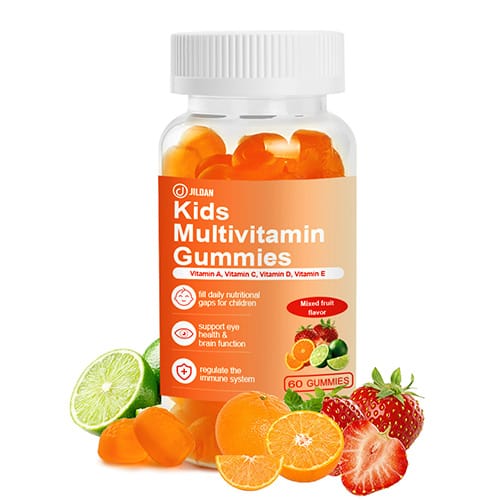
Age segmentation should come before ingredient selection.
A formula for children ages 2–3 is not necessarily appropriate for a seven-year-old, and a product intended for school-age children should not automatically use the same nutritional profile as a product designed for teenagers.
Die NIH multivitamin/mineral guidance emphasizes that formulations commonly differ by age, sex, and life stage.
This creates an important first step when developing Kinder Multivitamin-Muschis:
Define exactly who the product is for.
Possible segments might include:
- toddlers within an appropriate labeled age range;
- children ages 4 and older;
- school-age children;
- teenagers;
- broader family-oriented products with clearly differentiated serving instructions.
The age range affects:
- nutrient targets;
- Prozentualer Tageswert;
- Portionsgröße;
- Gummizahl;
- warning language;
- package instructions.
FDA labeling examples also distinguish Daily Value calculations for children ages 1 through 3 from those for adults and children age 4 and older. The agency provides examples of dual-column labeling where one product serves both groups. FDA Supplement Facts label examples illustrate this distinction.
For brands, the lesson is simple: the age range is part of the formulation, not just part of the marketing.
Do Not Build Kids Multivitamin Gummies Around the Longest Ingredient List
A long Supplement Facts panel can look impressive, but it does not automatically make a children’s supplement better.
Every nutrient added to Kinder Multivitamin-Muschis creates a formulation decision.
Fragen Sie:
- Is this nutrient relevant to the target age group?
- Is the proposed amount appropriate?
- Is it already commonly obtained from fortified foods?
- Does the ingredient fit physically into the gummy?
- Does it affect taste or texture?
- Is it stable in the gummy matrix?
- Could it create excessive intake when combined with other supplements?
NIH notes that multivitamin/mineral supplements have no single standard composition. Manufacturers determine which nutrients and quantities are included, and products vary widely.
That flexibility is useful, but it also means product developers need a rationale for each active.
A strong formula may focus on a practical group of nutrients rather than attempting to include every vitamin and mineral associated with childhood nutrition.
This approach can improve:
- Portionsgröße;
- Geschmack;
- Nährstoffstabilität;
- label clarity;
- manufacturing consistency.
Für Kinder Multivitamin-Muschis, formulation restraint can be a competitive advantage.
Age-Appropriate Nutrient Levels Matter More Than High Percent Daily Values
Brands sometimes use high percentage Daily Values as a way to make a product appear stronger.
That strategy needs particular caution with children.
Recommended nutrient intakes vary substantially by age.
For example, the NIH Vitamin A Fact Sheet lists recommended vitamin A intake at 300 mcg RAE per day for children ages 1–3 and 400 mcg RAE for ages 4–8.
For vitamin D, NIH lists 15 mcg, or 600 IU, per day for children ages 1–13. NIH Vitamin D guidance provides the age-specific reference values.
These figures are nutritional reference values, not automatic formulation instructions.
A child may receive nutrients from:
- food;
- angereicherte Lebensmittel;
- milk or other fortified beverages;
- individual supplements;
- other multivitamins.
Das bedeutet Kinder Multivitamin-Muschis should be developed within the context of total nutrient intake rather than assuming the gummy is the child’s only source.
A higher percentage is not automatically better.
The product should support an age-appropriate nutritional strategy rather than simply maximizing numbers on the label.
Vitamin Forms Can Change Stability and Product Performance
The front label may say vitamin A, vitamin C, vitamin D, or vitamin B12.
The formulation team has to work with specific chemical forms.
That matters because nutrient forms can differ in:
- Stabilität;
- Löslichkeit;
- Geschmack;
- Farbe;
- Kompatibilität;
- Verarbeitungsverhalten.
Für Kinder Multivitamin-Muschis, the selected vitamin form needs to work within a gummy matrix that contains moisture, sweeteners, acids, flavors, and a gelling system.
A nutrient that performs well in a dry capsule does not necessarily behave identically in a gummy.
Marken sollten den Hersteller fragen:
- Which form of each vitamin is proposed?
- Why was that form selected?
- Is it stable under the manufacturing process?
- Is it stable at the proposed gummy pH?
- Does it create taste or color problems?
- Does it require an overage?
This is particularly important for sensitive nutrients.
The manufacturer should select ingredient forms for technical reasons rather than simply choosing whichever raw material name sounds most attractive in marketing.
Brands considering an existing product platform can review JD Nutra’s Multivitamin-Gummis für Kinder as a starting point for discussions around serving design and customizable gummy development.
Vitamin D Is a Good Example of Why Context Matters
Vitamin D is frequently included in children’s multivitamin formulas.
Nach den NIH Office of Dietary Supplements, children ages 1–13 have an RDA of 15 mcg, equivalent to 600 IU, per day.
But this does not mean every serving of Kinder Multivitamin-Muschis should automatically contain that exact amount.
Formulators also need to consider:
- Zielalter;
- other dietary sources;
- intended servings per day;
- other vitamins in the product;
- label Daily Values;
- destination-market rules.
Vitamin D also needs to remain within specification throughout the product’s intended shelf life.
That means product development should connect:
nutritional target → ingredient form → manufacturing overage → stability → final label declaration.
This chain is more important than simply deciding on a headline vitamin D number.
Vitamin A Requires Particular Attention to Form and Total Intake
Vitamin A illustrates another reason why children’s formulas need careful nutritional design.
NIH distinguishes between preformed vitamin A and provitamin A carotenoids such as beta-carotene. The organization also publishes age-specific Recommended Dietary Allowances and Tolerable Upper Intake Levels for preformed vitamin A. NIH Vitamin A guidance provides the detailed tables.
For example, NIH lists the RDA at:
- 300 mcg RAE for ages 1–3;
- 400 mcg RAE for ages 4–8;
- 600 mcg RAE for ages 9–13.
This does not mean brands should simply copy those numbers into Kinder Multivitamin-Muschis.
It means vitamin A needs deliberate consideration of:
- Quelle;
- age group;
- total intake;
- other fortified foods;
- other supplements.
A children’s formula should not be built around the idea that the maximum possible amount is the ideal amount.
Iron Should Never Be Added to Kids Multivitamin Gummies Automatically
Iron is nutritionally important, but it is also one of the ingredients that deserves the most careful consideration in children’s supplement development.
NIH lists recommended iron intake at 7 mg per day for children ages 1–3, 10 mg for ages 4–8, and 8 mg for ages 9–13. NIH Iron Fact Sheet provides the age-specific reference values.
However, iron needs vary and unnecessary supplementation is not appropriate for every child.
Iron also presents gummy-formulation challenges:
- Metallischer Geschmack;
- Farbveränderungen;
- larger active load;
- potential ingredient interactions.
Most importantly, accidental excessive intake of iron by young children can be dangerous.
FDA requires a specific overdose warning on covered iron-containing dietary supplements in solid oral dosage form. Brands considering iron-containing Kinder Multivitamin-Muschis should obtain regulatory review to determine the requirements that apply to the exact product and market. FDA guidance on iron-containing supplement warnings explains the U.S. requirements.
For many brands, an iron-free formula may therefore make more sense unless iron is a deliberate part of the product strategy.
Iron should never be added merely because consumers expect a multivitamin to contain every mineral.
Mineral Loading Can Make a Gummy Formula Impractical
Even when a mineral makes nutritional sense, it may not fit the gummy format well.
Minerals often require substantially more raw-material mass than vitamins.
Calcium and magnesium are good examples.
Including meaningful quantities can increase:
- Gummigewicht;
- Gummis pro Portion;
- Kreidigkeit;
- Bitterkeit;
- manufacturing complexity.
NIH notes that many multivitamin/mineral supplements contain relatively small amounts of bulky nutrients such as calcium, magnesium, and potassium.
This is partly a physical formulation issue.
A brand developing Kinder Multivitamin-Muschis should therefore avoid asking the gummy to do everything.
If high mineral delivery is central to the product concept, another dosage form may be more appropriate.
The best children’s gummy formula respects the limits of the format.
Pectin or Gelatin Changes More Than the Ingredient List
The gummy base is an important product-development decision.
Pectin Kids Multivitamin Gummies
Pectin can support vegetarian or vegan positioning.
It typically requires careful control of:
- pH-Wert;
- Lösliche Feststoffe;
- Verarbeitungstemperatur;
- Feuchtigkeit;
- Einstellungsbedingungen.
Adding several vitamins and minerals can affect this balance.
Gelatin Kids Multivitamin Gummies
Gelatine erzeugt ein anderes Kau - und Elastizitätsprofil.
It can offer useful manufacturing characteristics, but it does not support vegan positioning.
Für Kinder Multivitamin-Muschis, the choice between pectin and gelatin should depend on:
- Markenpositionierung;
- Texturziel;
- Wirkstoffe;
- Verarbeitungsbedingungen;
- Stabilität.
The brand should determine the desired base before final flavor and stability work begins.
J. D. Nutras breiter Gummiergänzungsmittel Produktpalette can help brands compare children’s multivitamin concepts with other gummy platforms.
Sugar Strategy Needs to Balance Taste With Product Positioning
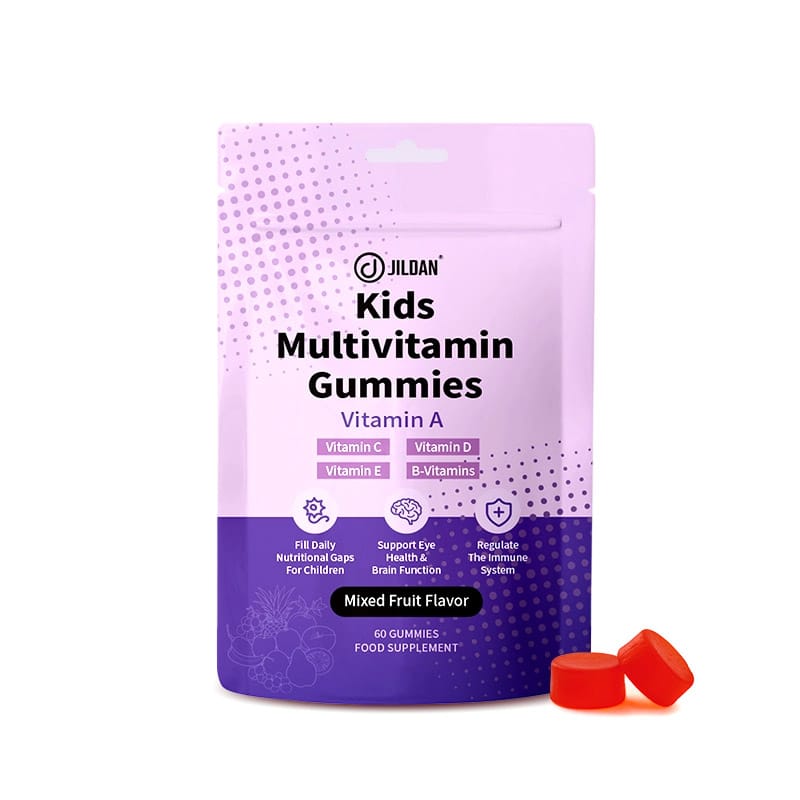
One of the most sensitive parent-facing questions around Kinder Multivitamin-Muschis is sugar.
Gummies need a pleasant sensory profile, but brands increasingly want:
- reduced-sugar products;
- sugar-free products;
- alternative sweetener systems.
Sugar is not just a flavor ingredient.
It contributes to:
- Süße;
- Feststoffen;
- Textur;
- Wasseraktivität;
- Verarbeitung;
- Haltbarkeit.
That means converting an existing formula into sugar-free Kinder Multivitamin-Muschis is not simply a matter of removing sucrose.
Alternative sweeteners and bulking ingredients can change:
- Gummigefügung;
- Nachgeschmack;
- Verdauungstoleranz;
- Stabilität;
- flavor masking.
The sugar strategy should therefore be selected before product development, not after an existing gummy has already been approved.
It is also important to communicate the final sugar content accurately rather than relying on vague claims such as “healthy candy.”
A dietary supplement for children should remain clearly positioned as a supplement.
Kids Multivitamin Gummies Should Not Look Too Much Like Candy
Consumer appeal is an advantage of gummies, but it can also create risk.
Children may not naturally distinguish between a colorful gummy supplement and confectionery.
Brands should therefore be cautious about:
- candy-like positioning;
- unrestricted access;
- oversized serving suggestions;
- packaging that encourages unsupervised use.
Für Kinder Multivitamin-Muschis, product design should support adult-controlled use.
Useful design considerations include:
- clear serving instructions;
- prominent age range;
- angemessene Warnsprache;
- secure storage messaging;
- packaging that is obviously a supplement.
The objective is to make daily use pleasant without encouraging the child to view the product as an unlimited snack.
This distinction becomes even more important when formulas contain nutrients that can create problems at excessive intakes.
Flavor Development Should Happen After the Active Formula Is Realistic
Children’s gummies need to taste good, but flavor should not be developed before the nutrient formula is technically realistic.
Vitamins and minerals can introduce:
- Bitterkeit;
- metallic notes;
- Säuregehalt;
- Aroma;
- Farbe.
A flavor that tastes excellent in a blank gummy base may behave very differently after the active ingredients are added.
Markenentwicklung Kinder Multivitamin-Muschis should therefore evaluate samples containing the actual intended nutrient blend.
Zu den üblichen Geschmacksrichtungen können gehören:
- Mischbeere;
- Erdbeere;
- Orange;
- tropical fruit;
- Pfirsich;
- mixed fruit.
The best option depends on the formula.
Flavor also needs to be assessed after storage.
A freshly manufactured gummy may taste different months later as:
- flavors change;
- moisture shifts;
- vitamins degrade;
- mineral notes become more noticeable.
Sensory stability should therefore be considered part of product quality.
Nutrient Overages Should Be Based on Stability, Not Guesswork
Some vitamins can decline during manufacturing or storage.
A manufacturer may compensate by using a controlled overage so that the labeled nutrient amount remains within specification during shelf life.
Für Kinder Multivitamin-Muschis, overages need particular care because the target users are children.
The objective is not simply to add as much extra nutrient as possible.
Overages should be based on factors such as:
- process losses;
- Nährstoffstabilität;
- Verpackung;
- Haltbarkeitsziel;
- Stabilitätsdaten.
Marken sollten fragen:
- Which vitamins require an overage?
- Why?
- What overage is used at manufacture?
- What result is expected at end of shelf life?
- What stability evidence supports that decision?
A technically justified overage is very different from arbitrary “insurance.”
The finished product should remain appropriate for the intended age group throughout its shelf life.
Stability Testing Should Include Both Nutrients and Gummy Quality
Multivitamin-Gummis für Kinder need to remain acceptable chemically and physically.
Chemical stability focuses on whether nutrients remain within specification.
Physical stability focuses on what happens to the gummy itself.
Over time, gummies can:
- Kleben; werden;
- Aushärten;
- Weich machen;
- Feuchtigkeit aufnehmen;
- Farbe ändern;
- Geschmack verlieren;
- develop undesirable aromas.
A comprehensive stability program may therefore evaluate:
- ausgewählte Vitaminpotenz;
- Feuchtigkeit;
- Textur;
- Erscheinung;
- Geschmack;
- Aroma;
- Mikrobiologische Qualität;
- Verpackungsintegrität.
The package used in stability testing should ideally match the intended commercial configuration.
Changing packaging after stability work begins can alter exposure to moisture, oxygen, and light.
Für Kinder Multivitamin-Muschis, the formula and package should be treated as one finished product system.
Packaging Should Help Parents Control Use
Packaging has two major roles in children’s supplements.
The first is product protection.
The second is use management.
For product protection, the package may need to control:
- Feuchtigkeit;
- Sauerstoff;
- Licht;
- Wiederholtes Öffnen.
For use management, it should make it easy for parents to understand:
- Portionsgröße;
- age group;
- Warnungen;
- Aufbewahrungshinweise.
The package should not create the impression that Kinder Multivitamin-Muschis are ordinary candy.
If the formula contains ingredients that require additional safety precautions, packaging strategy deserves even greater attention.
Brands should also consider the practical realities of ecommerce.
A package needs to maintain gummy quality after:
- Lagerhaltung;
- parcel transportation;
- temperature variation.
Package decisions should be made before commercial production, not after the formula has already been finalized.
Supplement Facts Need to Match the Intended Age Group
Children’s supplement labeling requires special care because Daily Values can differ by age.
FDA provides Supplement Facts label examples showing separate percentage Daily Value columns for children ages 1–3 and for adults and children age 4 and older when products are intended for both groups. FDA’s official Supplement Facts examples demonstrate the format.
Dies bedeutet Kinder Multivitamin-Muschis should have their target age group determined before artwork is finalized.
A formulation change can alter:
- nutrient quantities;
- percentage Daily Values;
- Portionsgröße;
- ingredient list.
The formula, manufacturing specification, and Supplement Facts panel should therefore remain aligned.
Brands should not finalize packaging based on an early concept formula.
Kids Multivitamin Gummies Should Complement a Healthy Diet
One of the most useful messages a children’s supplement brand can communicate is also one of the least dramatic:
A multivitamin is not a substitute for a varied diet.
Die NIH Office of Dietary Supplements states that multivitamin/mineral supplements cannot replace eating a variety of foods because foods provide dietary fiber and other components in addition to vitamins and minerals.
This is important for Kinder Multivitamin-Muschis marketing.
Product content should avoid implying that a gummy:
- replaces vegetables;
- replaces a balanced diet;
- guarantees normal growth;
- prevents illness.
A more credible product story explains that the supplement is intended to complement an overall nutrition strategy.
This type of language can actually strengthen parent trust because it avoids unrealistic promises.
Health Claims Need to Stay Within the Evidence
Children’s health is a sensitive category.
Claims around immunity, brain function, eyesight, growth, development, energy, and bone health need to be based on the actual nutrients and amounts in the finished product.
Brands should avoid turning Kinder Multivitamin-Muschis into a collection of every possible benefit associated with vitamins.
A stronger approach is to connect each intended claim to:
- specific nutrient;
- Lieferbetrag;
- relevant evidence;
- applicable regulatory requirements.
For U.S.-market products, brands should review the Leitfaden zur Etikettierung von FDA-Diätpräparaten Vor der endgültigen Etikettensprache.
The product should never be positioned as diagnosing, treating, curing, or preventing a childhood disease.
Finished-Product Testing Should Verify the Commercial Gummy
Raw-material documentation alone is not enough.
Once vitamins and minerals enter production, they undergo:
- Wiegen;
- Vormischen;
- Verarbeitung;
- Hinterlegen;
- Trocknen oder Konditionieren;
- Verpackung.
Das Fertig Kinder Multivitamin-Muschis should therefore have their own quality specification.
Depending on the product, this may include:
- Erscheinung;
- Gummigewicht;
- Ausgewählte Nährstoffpotenz;
- Mikrobiologische Qualität;
- Relevante Schadstoffgrenzwerte;
- Feuchtigkeit;
- Verpackungsintegrität.
Low-dose nutrients require particular attention to mixing and distribution.
A microgram-level vitamin needs to be distributed consistently throughout a much larger gummy batch.
Manufacturers should be able to explain:
- how premixes are prepared;
- how uniformity is managed;
- where samples are collected;
- what appears on the finished-product COA.
This is especially important in children’s formulas because large unit-to-unit variation is undesirable.
How to Evaluate a Kids Multivitamin Gummies Manufacturer
The right manufacturer needs experience in both gummy processing and micronutrient formulation.
Brands should ask questions in several categories.
Nutritional Formulation
- How is the target age group incorporated into formula design?
- Welche Nährformen sind empfehlenswert?
- Which ingredients are difficult to fit into gummies?
- How are upper intake concerns reviewed?
Active Uniformity
- How are low-dose vitamins premixed?
- How is batch uniformity controlled?
- Which nutrients are tested in finished products?
Gummy-Technologie
- Can pectin and gelatin formats be produced?
- Are reduced-sugar or sugar-free systems available?
- How are flavor and texture developed?
Stabilität
- Welche Nährstoffe werden überwacht?
- Is aged flavor and texture evaluated?
- Is the final commercial packaging used?
Etikettierung
- Can age-specific Supplement Facts requirements be supported?
- How are serving sizes coordinated with the final formula?
Qualitätskontrolle
- Was beinhaltet das Fertigprodukt COA?
- Wie werden Abweichungen gehandhabt?
- Who releases the commercial batch?
Marken können die bestehenden von JD Nutra überprüfen Leitfaden zur Formulierung von Multivitamin-Gummis und Qualitätskontrollhandbuch für Multivitamin-Mumien Hersteller before preparing a more specific children’s product brief.
What to Include in a Kids Multivitamin Gummies RFQ
A detailed RFQ helps avoid formula revisions later.
Für Kinder Multivitamin-Muschis, Einschließen:
Zielalter
Specify the exact intended age range.
Nutrient Profile
Liste:
- required vitamins;
- required minerals;
- preferred ingredient forms;
- Zielbeträge;
- nutrients to exclude.
Gummy-Format
Definieren:
- Pektin oder Gelatine;
- Gummis pro Portion;
- Gummigröße;
- Geschmack;
- Farbe.
Zuckerstrategie
Angeben:
- Konventionell;
- Zucker reduziert;
- Zuckerfrei.
Qualitätsanforderungen
Einschließen:
- Potenzvorgaben;
- Mikrobiologische Spezifikationen;
- Schadstoffanforderungen;
- Fertigproduktprüfung;
- Stabilitätserwartungen.
Verpackung
Definieren:
- Flasche oder Beutel;
- zählen;
- Schließung;
- Etikett;
- Karton bei Bedarf.
Markt
Staat:
- destination country;
- intended sales channel;
- labeling language.
When the target age, nutrient profile, gummy system, packaging, and market are clear, Kontakt JD Nutra to discuss technical feasibility and sampling.
Common Mistakes Brands Make With Kids Multivitamin Gummies
Copying an Adult Formula
Children need age-appropriate formulation and labeling.
Using High Daily Values as the Main Selling Point
More is not automatically better.
Including Every Possible Mineral
Some minerals create excessive active load and poor sensory performance.
Adding Iron Without a Clear Reason
Iron requires both nutritional and safety review.
Developing Flavor Before Finalizing the Actives
The real nutrient blend can change taste significantly.
Treating Sugar-Free as a Simple Ingredient Swap
Changing the sweetener system can change texture, water activity, and stability.
Making the Gummies Look Too Much Like Candy
The product should remain clearly recognizable as a dietary supplement.
Fertigstellung der Kunstwerke zu früh
Age range, serving size, nutrient levels, and percentage Daily Values need to be stable first.
Stabilität ignorieren
The formulation must remain acceptable through the intended shelf life, not just on manufacturing day.
FAQ
Was sind Multivitamin-Gummis für Kinder?
Multivitamin-Gummis für Kinder are chewable dietary supplements formulated with combinations of vitamins, minerals, and sometimes other ingredients for a defined child age group.
The formula should be designed specifically for that population rather than copied directly from an adult supplement.
Do All Children Need Kids Multivitamin Gummies?
Nein.
Individual nutrient needs vary according to diet, age, health status, and other factors. NIH emphasizes that nutritional needs should generally be met through food and beverages when possible, with supplements serving particular nutritional purposes when needed. NIH Multivitamin Consumer Fact Sheet provides additional guidance.
How Much Vitamin D Should Children Get?
NIH lists the RDA for vitamin D at 15 mcg, or 600 IU, per day for children ages 1–13. This is a reference intake, not an automatic recommendation for the amount that every gummy supplement should contain.
Sollten Multivitamin-Gummis für Kinder Eisen enthalten?
Not automatically.
The decision should reflect the target child population, total diet, formula design, safety considerations, and professional or regulatory review.
Können Multivitamin-Gummis für Kinder vegan sein?
Ja.
Pektinbasiert Kinder Multivitamin-Muschis can support vegan positioning when all active and inactive ingredients also meet the relevant requirements.
Können Multivitamin-Gummis für Kinder zuckerfrei sein?
Yes, but a sugar-free formulation should be specifically developed for the intended sweetener and bulking system rather than created by simply removing sugar from a conventional gummy.
How Should Kids Multivitamin Gummies Be Labeled for Different Ages?
FDA provides different Daily Value frameworks for children ages 1–3 and people age 4 and older. Products intended for multiple age groups may require appropriate age-specific presentation. FDA Supplement Facts label examples provide official examples.
What Should Brands Ask a Kids Multivitamin Gummies Manufacturer?
Ask how the manufacturer handles age-specific nutrient formulation, micronutrient uniformity, vitamin overages, gummy stability, sugar strategy, packaging, finished-product testing, and Supplement Facts alignment.
Schlussfolgerung
Erfolgreich entwickeln Kinder Multivitamin-Muschis requires much more than choosing popular vitamins and creating a fruit-flavored gummy.
The product should begin with a clearly defined age group.
From there, brands need to select nutrients and amounts that fit the intended consumer, choose technically appropriate vitamin and mineral forms, evaluate total nutrient intake, and respect the physical limitations of the gummy format.
Special attention should be given to nutrients such as vitamin A, vitamin D, and iron because age-specific reference intakes, upper limits, and safety considerations can materially affect formulation decisions.
Das Beste Kinder Multivitamin-Muschis also need to work outside the laboratory.
They must:
- taste acceptable;
- remain physically stable;
- maintain nutrient potency;
- use appropriate packaging;
- provide clear age-specific directions;
- avoid encouraging candy-like consumption;
- support accurate Supplement Facts labeling.
For supplement brands, this creates a useful competitive advantage.
Instead of competing on the longest ingredient list or highest percentage Daily Values, brands can compete on thoughtful age-specific formulation, clear labeling, stable nutrient delivery, responsible positioning, and parent-friendly product design.
Brands developing this category can review JD Nutra’s Multivitamin-Gummis für Kinder, explore the broader Fertigungsbereich für Gummiegänzungsmittel, and read the existing Leitfaden zur Formulierung von Multivitamin-Gummis.
For a deeper look at manufacturing controls, nutrient overages, finished-product testing, and COAs, see JD Nutra’s Qualitätskontrollhandbuch für Multivitamin-Mumien Hersteller.
When the age group, nutrient profile, gummy base, sugar strategy, testing requirements, packaging, and destination market are defined, Kontakt JD Nutra Formulierungsdurchführbarkeit und kommerzielle Fertigung zu diskutieren.


